“Why”
Collected habits,
mosaic of rituals,
forming new outlook.
Steve D

Collected habits,
mosaic of rituals,
forming new outlook.
Steve D
Much has happened in the last month and a half which (mostly) explains my absence from this site. Primarily, I was laid off from my job last month and have been interviewing for a couple of new roles in the meantime. The family is doing well, and I’m confident I’ll land a new job soon.
And if not… we’ll see.
Being laid off, while not fun, presents an interesting opportunity. I had been burned out and overly stressed at my last job for quite some time. More than anything, I have felt relieved since leaving. It has given me a chance to think about all the things I haven’t had much brain space or time to pursue for the last year or so. Writing, music, exercise, community work, alternative career paths.
So, this Write Day post is a bit of a fresh start after this recent hiatus. I’m not going to bother with my last set of goals, which I posted before Thanksgiving. Instead, I’m going to outline where I’m at for the moment, and how I’d like for this interim period to go before I start a new job — whether that’s in two weeks or in two months.
I’m attempting to meditate more regularly after not really doing much of it for several months. My current strategy includes two short sessions: the first to set my intention, focus on breathing, and clear my mind. The second is to allow for reflection, and I try to provide guidance to myself with a question or a challenge that’s ahead of me for the day.
This has been a long-standing and under-achieved goal of mine for… too long. Now, with additional time on my hands, I’m taking the opportunity to just figure out what I want from an exercise routine. I know I need to exercise. I just need to do it in a way that is motivating and enjoyable.
For now, I’ve settled on alternating guided yoga flows with weight-lifting at the gym. The difference from my previous gym habits is that I’m designing a routine that assumes I only go to the gym about three times per week. As a twenty-something, weight-lifting had made up nearly the entirety of my exercise. Now, as a late-thirty-something, I want to focus on mobility and flexibility as much as strength, and I think I’ve come up with a basic routine to strike that balance.
I’m not going into detail, but I’m in the midst of handling some financial changes for my dad. It’s been a long time in the making, and it will take quite a load off my shoulders once all is settled in the next few weeks. I would have been doing this even if I hadn’t been laid off. Now, I’m actually able to focus on it.
I need to get involved locally. I’ve had this burning drive to do so for the last year or more, fueled in equal parts by restlessness in my own world and rage at the state of the wider world. I’ve reached out to one local organization where I have a connection, and while they’re not seeking volunteers at the moment, I expect to get involved with them later this year.
Until then, I would like to put in some volunteer hours with another local organization. This will depend on when I start a potential new job, but I know that it will also keep me active and cure some of my restlessness.
I need to build some damn shelves in my shed, and I need to install a double-end bag so I can get back into some boxing training (part of my ideal exercise routine). Each project should only take a couple hours, so I’m hoping to have one done tomorrow or Friday.
I’ve been thinking a lot about my writing: why I want to write, what I want to get from it, whether and how I want to publish. The bones of a plan have begun to take shape in my mind. I think I know which stories I want to focus on — largely the same ones I had been.
I think I also now know how I want to go about publishing. Primarily, I want to do it myself, not just in the self-publisher print-on-demand way, but in sourcing more dedicated printing services to stay off the big platforms. I don’t know what exactly this will look like, or even when I will be able to put real time into it, but one thing is certain. I know that this idea feels good, and that’s enough for me.
This post ended up being quite a bit longer than I anticipated, but I suppose it was overdue. I definitely want to get back to posting here regularly. I have a backlog of book reviews to publish, and I haven’t written a haiku in weeks.
That’s it for now, though.
Steve D

Little waxy length,
to light an unburned candle,
and share light anew.
Steve D
Let not rage of heart
guide clenched fists to violence,
but to open aid.
Steve D

Temporary sheen,
briefest sign of clean before
scuffs from little feet.
Steve D
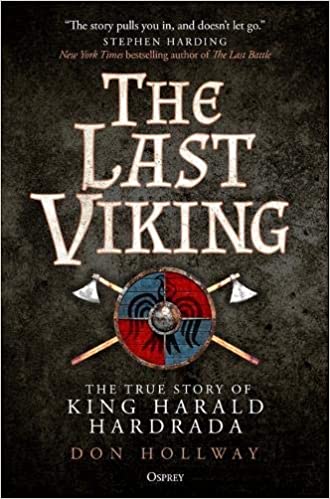
I am woefully behind on posting book reviews, which is perhaps a good thing. It means I’ve at least been keeping up with my reading. So here goes an attempted book review for a book I finished almost a month ago.
I listened to The Last Viking: The True Story of King Harald Hardrada by Don Hollway on audiobook, and it reminded me of the pleasing rhythm of well-constructed narrative history.
King Harald Hardrada was, as Hollway argues, the last great figure of the Viking age of Norse history. After his older brother, King Olaf of Norway, is killed in battle, the young Harald embarks on a wild life’s journey that takes him opposite corners of Europe, until his death in 1066.
Hollway uses a combination of historical sources and dramatized dialogue and exposition to weave together this history of Harald Hardrada’s life. His open discussion of his sources (or lack thereof, at times) and their veracity lends credibility to his understanding of Harald’s life. We have to take the information we have about a person who appears larger than life. Hollway then builds a narrative and life journey fit for a figure who appeared to be legendary in his own time.
To open the book, Hollway cleverly sets the scene for the battle of Stamford Bridge in England, 1066, where King Harald Hardrada of Norway met King Harold the Saxon, of Wessex.
Before the battle begins, Hollway winds the clock back to Harald’s youth. Following the death of his brother, the book follows Harald as he makes his way down the Volga and ultimately to Constantinople, becomes embroiled in the imperial court, and escapes as the reign of Constantine II collapses.
Harald then returns to his homeland and attempts to conquer parts of Sweden and Denmark from his seat in Norway, before finally embarking on his expedition to conquer England. This framing leads to a surprisingly climactic end for Harald, in which Hollway deservedly places him among the most influential figures of his time.
The Last Viking is an excellent read for anyone interested in the early medieval period of Northern Europe or the Byzantine period. For me personally, this book tugged at multiple threads in the history of side of my brain, and only reinforces my growing obsession with the early-Medieval period in Britain, and now Scandanavia.
Steve D
Serene winter night,
warmed by amber candlelight,
portent of sun bright.
Steve D
Creativity
flows, or rather, stacks like bricks.
Miniature play.
Steve D
Excitement borders
on impatience for the day
of toy unwrapping.
Steve D

Years of history,
momentary connections,
dormant roots regrown.
Steve D
 Evening Satellite Publishing