“Blue”
Eyes bright with wonder
unveiling your thoughts and hopes
one glimpse at a time.
Steve D

Eyes bright with wonder
unveiling your thoughts and hopes
one glimpse at a time.
Steve D

After some lackluster reading recently, I am embarking on an epic quest: to reread The Lord of the Rings! I will not be reviewing these stories in a critical sense, because how could I? Instead, I will share some storytelling insights I pick up as I go along.
This will be primarily focused on the books, but I will also reference the films by Peter Jackson to compare the stories as they are told between these two media. See part 1 and part 2.
It’s been nearly two months since my last entry in this mini-series, so I thought I’d provide some additional thoughts. I am almost halfway through The Return of the King and only just now realizing that I read through all of The Two Towers without a single post like this. Oh well. I’ll try to highlight some story lessons from the last book-and-a-half and then perhaps wrap up this mini-series once I’ve completed book three.
Like last time, I’m just going to jump in. I’ll try to keep these in chronological order relative to the sections/chapters that inspired them.
Tolkien is obviously known for his world-building prowess, but I think there are several examples of this that are not talked about often, and which particularly intrigued me.
The first is several references between books 2 and 3 to the “war in the north”, a large assault that Sauron sent from the Black Gate to the kingdoms of Dale and Erebor, where the descendants of Dane and Bard had to hold their own against virtual annihilation. I haven’t yet read the appendices at the end of The Return of the King, but I know this is referenced somewhere in there.
Still, it’s astonishing to me that a massive part of the War of the Ring is mentioned only in passing. I want to read about the war in the north! Can you imagine how long this series would have been if Tolkien had actually included the different battlefronts? That would have been at least two additional books.
Anyway, I think this point is lost on movie viewers. Peter Jackson’s films, by necessity, focus on the immediate battles shown in the books, but to casual viewers, it makes it seem like the war was fought and won in exactly two battles — four if you count the skirmishes between Faramir’s forces and the Haradrim, and the last defense of Osgiliath.
The second time I really felt the wider world was in the third book when the Rohirrim are marching to Gondor. They apss through the woods, where Wild Men guide them in secret past additional forces Sauron had sent into Rohan, thus allowing them to reach Minas Tirith in the midst of its siege.
In the chapters leading up to the Battle of the Pelennor Fields, both Merry and Pippin express to various characters that this coming war feels too big for them to have any real part. This is exemplified in Pippin’s offer of service to Denethor, where he admits that his service may be of little use to the Steward of Gondor, and when Merry pleads with Theoden to allow him to ride with the Rohirrim to battle and is subsequently denied.
Not only did these characters feel the dread leading up to the battle, but they also could not believe their experiences after the fact. Pippin sits with Merry in “The Houses of Healing”, where Merry expresses his own insignificance in this war:
Still there are things deeper and higher; and not a gaffer could tend his garden in peace but for them, whether he knows about them or not.”
Tolkien, J.R.R. The Return of the King, Ballantine Books, 1965, pp. 179.
I intended for this post to be shorter than previous installments and it somehow ended up longer. I’m cutting myself off.
Steve D
Months of separation,
disconnected, specter friends,
until met again.
Steve D
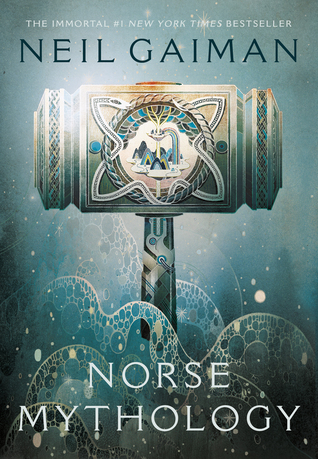
I love reading mythology, and especially the Norse myths. I was first introduced to them as part of a world mythology book I read as a kid. The intricacies of fantasy universes like Redwall and Middle Earth would each serve as a form of mythos for me, providing me with clear moral codes and heroes and beings of immense power to admire and emulate.
A few years ago, I read The Norse Myths, a collection of the mythos collected by Kevin Crossley-Holland, pulling primarily from Snorri Sturluson’s recordings of them in 13th-century Iceland. This annotated compendium exposed me to a much more academic view of mythology, which was just as enthralling as the children’s stories I’d read previously.
This is all to say that Neil Gaiman’s Norse Mythology is not my first pass at these stories, and it will certainly not be my last. Even still, I cannot emphasize how much pleasure I took from this particular telling
I listened to the audiobook version of this, and I don’t know how anyone can read Gaiman any other way. He is a master storyteller as both a writer and a narrator, and his inflection, his voices, and his enthusiasm for the story enliven everything he narrates. Listening to Gaiman tell a story is like someone lighting a candle in pitch black that illuminates the book in your mind for the first time.
Gaiman presents the Norse myths in a style that is remarkably accessible to the modern reader but does not detract in any way from the power, the wonder, and the downright strangeness of these stories. His chapters are renamed as well to appeal to a modern audience. Rather than regaling us in epic-style prose in “The Lay of Thrym”, Gaiman instead recounts a fireside tale of “Thor’s Journey to the Land of the Giants”, which he describes with a nod both to the hilarity and the foreshadowed danger of Thor allowing Loki to dress him as the goddess Freya in order to trick the powerful giant Thrym.
As is expected with any Gaiman story, the dialogue is punchy and entertaining, and his dry sense of humor permeates both the absurdity and the fatalism of the Norse myths.
By the time the reader reaches “The Last Days of Loki” and “Ragnarok”, the weight of the end times lends greater meaning to Gaiman’s words, and to the hopefulness with which he describes what comes after the end times.
I thoroughly enjoyed this listen and will absolutely be listening to it again… perhaps on a road trip with my kids as part of their introduction to the Norse myths.
Steve D
Dignified eyebrows
and tuft beard gives little pup
an old dog spirit.
Steve D

We’re almost halfway through 2021, which is weird. I went into a long-weekend stay at the family lake house ready for summer, and we got near-winter temperatures and rain, so it definitely doesn’t feel like we’ve hit summer to me.
I also don’t like the notion that I only have half a year to get two stories ready for publication… I need a vacation.
No, but I wrote over 6,000 words, which is my best total since January. As I wrote a couple weeks ago, I’ve been trying to write after work more to avoid needing to motivate later at night when I’m definitely more tired and usually lazier.
That strategy largely paid off in May. I wrote 12 days, even with a 4-day mini vacation for Memorial Day weekend and averaged over 500 words per session.
My main weak spots were at the beginning of the month (again), and the final weekend, when we took said mini vacation and I was away from my home computer. 10 of my 12 writing days came between May 12 and 25, meaning I just need to be more consistent at the beginning of the month.
I’m already off to a decent start for June. I wrote after work yesterday and feel like I have some solid momentum on my rewrite of Uprooted, The Herb Witch Tales #1.
I definitely did not meet my goal of 7,500 words written, but I feel really good about this trajectory, and I’m motivated to keep it going in June, a short month where I have one weekend of little to no writing ahead of me.
I don’t think so, but I feel like I came close. Near the end of the month, I completed the final in a series of yoga videos from Yoga with Adrienne on YouTube. I feel like her videos have helped my technique a ton — breathing and otherwise. However, I was missing a workout element from my yoga. So I went back to Sarah Beth Yoga, who focuses more on the workout aspect, and man, it was great. I’ll probably alternate between the two channels and yoga styles for the time being, as the mood catches me.
I definitely got back into my resistance exercises towards the end of the month, but a nagging soreness in my left hand isn’t helping. I’ve also become the guy who uses a trip to the playground with his kid to do pull-ups on the monkey bars. So there’s that.
I only finished one book in May. I’m just about finished with The Two Towers and have two other Audible shorts in progress. My LoTR re-read slowed a bit because the book is split between two halves: the first half focused on Aragorn, Gimli, Legolas, and the rest of the Company, and the second half on Frodo and Sam over about the same time period.
I’ve enjoyed the Frodo/Sam sections–and they in fact grew on me the more I read, particularly the fascinating chapters with Faramir–but the structure just caught me off guard. I had been really into the Rohan storyline, basically unable to put the book down, and I didn’t realize it was ending when the second part opened.
I said I didn’t want to rush through Tolkien and I’m glad I haven’t. Anyway, I’m almost done with book 2 and will move on to Th Return of the King this week.
Steve D
Watch expressions shift.
What thoughts flicker behind eyes.
Discovering you.
Steve D
Footprint sticks in mud
resisting every next step,
stamping down in spite.
Steve D
A hundred marbles
clatter to the floor to clack
in all directions.
Steve D
Now that we’re nearly five months through the year, and with my writing progress not going as quickly as I had hoped to this point, I’d like to take a look at the particulars of my writing habits this year. This is on my mind, because I’d like to start doing conventions again in 2022, and I would like to have some new material to showcase.
My ongoing work-in-progress has been a two-part novella that I will publish as separate stories in ebook and then print as one volume for conventions: Uprooted, The Herb Witch Tales #1 and [untitled], The Herb Witch Tales #2. I haven’t technically finished the first draft of part 2, and I am really only just starting a third revision of part 1, followed by a pretty significant overhaul of part 2.
In short: I’m not nearly as far along in this process as I had hoped to be, considering I would like to have these stories published and ready for readers in the next 12 months, if not less.
So, I’m going to examine my own writing progress so far this year and try to identify where I can improve — aside from just Writing More.
First let’s look at the overall progress I’ve made month to month compared to my goals for those months:
Okay, that’s not bad. I came up short, but still made really solid progress.
The last three months were markedly worse, although after a significant drop-off in writing productivity in February, I’ve started to climb back up.
Still, that’s a deficit of 7,728 words written in the first four months of this year. Let’s break this down further.

That image is from my NaNoWriMo writing goals tracker, which I’ve been using all year to track my daily writing progress and my monthly goals. The light blue line is a daily average to achieve my writing goal for the month; the dark blue line is my actual writing progress. Looking at my January progress above, a few things become immediately apparent:
There are some obvious conclusions to draw there, but let’s look at the other months first.
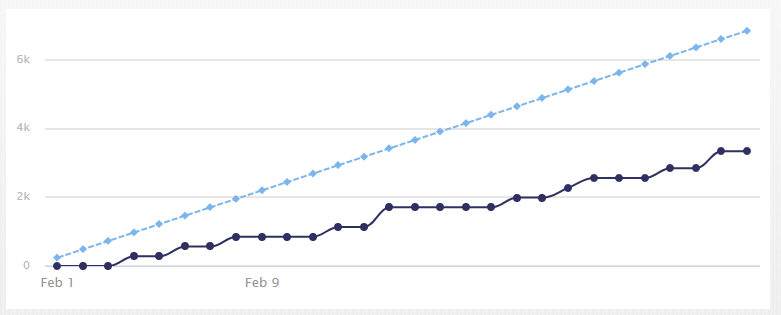
There’s February. My progress was a little steadier, but I still only logged progress 10 days out of 28. There are also two noticeable gaps where I went a few days without any progress. My pace looks steadier in that line graph than in January, but I just didn’t write enough.
And it’s much the same story for March and April, respectively. I don’t want to overload this post with screenshots of line graphs, so I’ll just summarize those months:
So out of 120 possible writing days from January through April, I only logged writing progress on 32 days. That’s time spent writing only 26% of available days. If I extrapolated that across the year, I would only write about 95 days in 2021.
I’m never going to be an everyday writer, and I haven’t tried to be in a long time, but I feel like that effort is pitifully low.
For the 32 days I actually sat down to write, my average word count per session is 566, which is honestly higher than I expected. If I can have that same kind of output over the course of more days, my writing progress could take a noticeable leap.
I’ve also had a habit of getting a late start in in the month, going several days or even a week before logging my first writing progress. This leaves me far behind my goal and scrambling to catch up.
Finally, I too often have gaps of 3+ days between writing sessions. That is obviously part of what contributes to me only writing somewhere around 10 days out of each month. I just need to write more consistently.
As I said at the top, I need to be a bit more proactive than just trying to Write More. I need a better strategy to fit writing into my day, even if it’s not every single day.
I started to try one new strategy at the end of April, and it really seemed to help. I think it’s also helping me write mote often in May.
I started to bake writing time into the end of my work day. I’m still working from home for at least the next couple months, so I started to logoff my work computer around the usual time, and then login to my personal/writing computer for 15 minutes or even up to an hour to focus on writing.
This allows me to use the mental energy that I typically still have at the end of my work day to focus on my writing. Otherwise, I logoff work, spend time with the family, prepare/clean up after dinner, try to relax a bit, and by that point it’s 9 or 10, and I’m exhausted.
Writing immediately after work allows me to decompress, tends to be more fruitful than writing later in the night when I’m tired, and allows me to relax with my family more without the weight of not-writing hanging over me.
I’ve written 7 out of 18 days in May so far, and my word count per session is around 400. With two busy weekends in a row coming up, I need these post-work writing sessions to carry me for the rest of the month. We’ll see how it goes, but this is already working better for me than my previous non-strategy.
Steve D

