“Tidal”
Brine and seaweed flood
pool in sand with ebbing tides
in miniature.
Steve D


Brine and seaweed flood
pool in sand with ebbing tides
in miniature.
Steve D

Family, neighbors,
come together to foster
sense of belonging.
Steve D

Scratch of pen or blade,
left to stain, or sting, the skin,
and be remembered.
Steve D

Among my greatest literary addictions is historical fiction, especially that of pre-Norman Britain. Thus, it was only a matter of time before I came across, immediately bought, and read Boudica: Dreaming the Eagle, by Manda Scott.
This is the epic telling of Boudica, the Warrior Queen of the Celts who led the Celtic tribes of Britain against Rome’s second invasion in the first century BCE.
One of my favorite acknowledgments of this book is when Scott describes that very little – almost nothing, in fact – is actually known about who Boudica was, so most of the story of her life, her family, and the people whose lives she influenced are fictional.
Even still, this is a period in history that is so well-researched that the world comes to life from the very first chapter. Scott fully acknowledges the immensity of historical and archaeological resources and experts she leans on to construct this work. The payoff is a style of world-building and character-driven exposition that feels organic and does not overwhelm the reader yet completely envelops them.
The story generally follows the young Boudica – before she earns that title – and various members of her tribe as they prepare for the Roman legions to return to their shores. The characters’ connection to each other, through inter-tribal politics and vows of personal honor, drive the emotional weight of the story.
This book has brutal depictions of war, but Scott deftly works around the gory details to paint the tapestry of a battle from the perceptions of those involved. The reader can see the battle play out in their mind’s eye but does not need to be told about every stroke of a blade or every spurt of blood. The horrors of war are apparent without being gratuitous.
Scott’s narrative is incredibly detailed with not a single word or metaphor wasted. Her prose is elegant and precise, where dialogue between characters does not have to reveal every single thought in order to convey deep meaning.
This is flat out one of the best epic novels I’ve read. I’m already reading book two, Boudica: Dreaming the Bull.
Steve D
April was a busy month. We had weekend plans three weeks in a row for various reasons and did a bit of traveling for family engagements. I’ve also been dealing with some family medical issues, so a lot of my hobbies/routines took a back seat, for better or worse.
We’re already halfway into May, and I can’t say much has changed to this point.
I finished one book in April, the previously reviewed A Closed and Common Orbit. Otherwise, I’ve continued picking my way through two longer reads.
Manda Scott’s Boudica: Dreaming the Eagle is a fantastic historical fiction, and I’m relishing every moment of it. I’ve found myself rewinding (the audiobook) to ensure I don’t miss any sections.
I’ve also been watching Andor season 2 after binging a season 1 rewatch in about a week. There is tons of great analysis about Andor happening all over the place, so I will just say that this is one of my favorite shows of all time. No question.
2 decent workout sessions, 4 shorter workout sessions. I feel like I’ve been stretching fairly consistently, although I haven’t been tracking that. Stretching is now as much about working stiffness out of my legs as anything else, so it’s much more of a habit.
I’m finding ways to get different types of exercise, like chopping wood/moving logs, yard work, playing soccer with my sons, etc. I definitely enjoy doing activities like that outside, so the exercise is just a bonus.
I didn’t do much writing in April, and my posts on this site give it away: four total in April, and this is my first post for May. Part of it is that I haven’t had any new book reviews to post.
I’ve been thinking about my duology a bit recently, as a piece that I feel deserves to see the light of day. I just haven’t come up with a publishing plan. At this point, I’d like to have the goal in sight as I’m working on it, and that just hasn’t been a priority. So, I will return to it at some point. I’m just not sure when right now.
I fell off this routine quite a bit in April for no real reason at all. I’d like to get back to it, so I’ll start tonight.
What keeps you in place,
reticence? Or do you wait,
for the bell to toll?
Steve D

After gulping down the audiobook form of The Long Way to a Small, Angry Planet, Becky Chambers’s first in the Wayfarer series, I did not hesitate to pick up book 2: A Closed and Common Orbit.
I had thoroughly enjoyed the first series entrant as a galaxy-crossing sci-fi adventure, so I was a caught a bit off guard to discover that I would spend all of book 2 with characters who were only a footnote in book 1.
Part of this is my fault, because I neglected to read the blurb before purchasing and beginning A Closed and Common Orbit. So I was a bit surprised, a little confused, and then curious.
This book follows Pepper, a tech whom the crew of The Wayfarer encounter in book 1, and Sidra, a conscious AI placed into a human-like body. Pepper’s and Sidra’s stories meshed well and approached themes of identity, predestination, and humanity with thoughtfulness. The two spend much of the book trying to navigate their own senses of self, while also figuring out how to integrate Sidra into Personhood and the local society of pepper’s home city.
Pepper’s story also looks backward, beginning with her life a child to explore how she got where she is. I was intrigued by Pepper’s hardships as a teenager, and I felt that her transition from that life into the one she built for herself was glossed over. However, her backstory clearly focused on and succeeded with explaining why she has such an affinity for advanced AI’s and their personhood.
Both character arcs are effective in demonstrating and resolving their respective emotional journeys.
Surrounding these very intimate themes of identity, the story barely touched on how Pepper’s and Sidra’s society did not accept AI’s as People, and what that might mean for Sidra. I would have liked to understand more about how technology and sapient AI was viewed and treated in the Galactic Commons at large.
Rich world-building surrounds this story, but it’s a little too focused on the characters’ internal struggles. I kept looking for a broader view to balance the intense personal stakes of the story. Similar to its predecessor, A Closed and Common Orbit excels in displaying what life is like for people on this planet, a sort of cozy sci-fi setting for these poignant themes.
Still, this was very much worth the read, and I’m interested in continuing this series in the near future.
For the audiobook, I found the narration stilted with unnatural inflection in many places, especially with dialogue. I think this may have been intentional by the narrator to reflect Sidra’s voice as an AI, but it honestly became more and more grating as the story proceeded.
Steve D
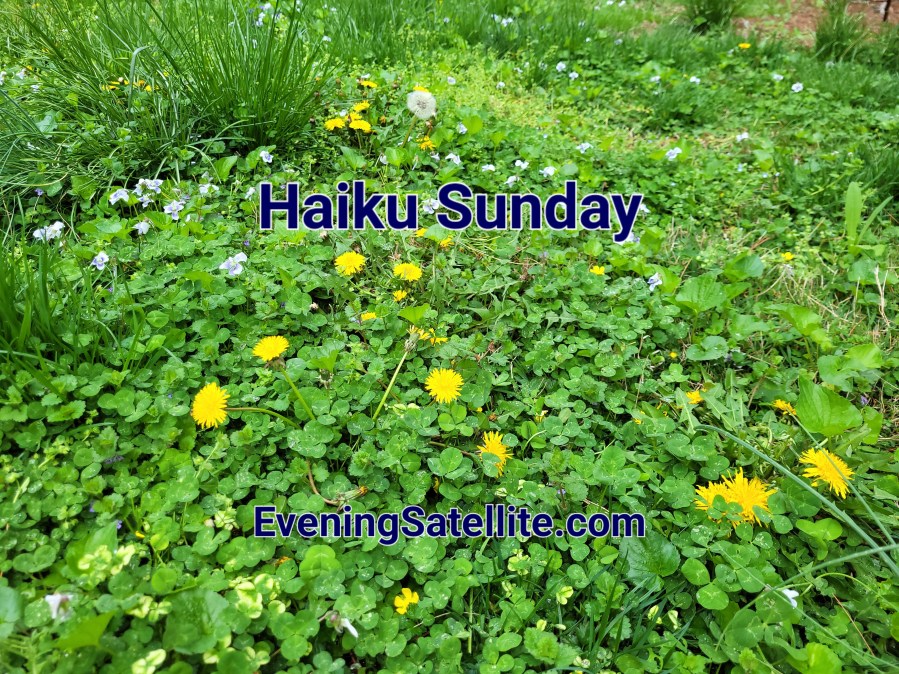
Fresh dirt clods exposed,
untapped dark soil revealed,
to invite new growth.
Steve D
I don’t remember much about March except that it was stressful. Lots of family obligations. A long weekend trip for my grandmother’s funeral. And some work things to keep me occupied.
My grandmother’s funeral was bittersweet in the appropriate way. We saw a lot of family we don’t see very often, and the entire service provided some much-needed closure on her years-long battle with Alzheimer’s.
The drive back from the Midwest was like seeing the transition from winter to spring in real time. As we crossed the Appalachians, the grass became greener, and more trees sprouted buds. In the Maryland piedmont we found many trees with new leaves, and plenty of undergrowth. I’m glad spring is here.
Yes! I finished Aspects by John M. Ford, and then powered through audiobook versions of The Long Way to a Small, Angry Planet and A Closed and Common Orbit, by Becky Chambers.
Beginning with Aspects for my first Ford read is likely not ideal, since he passed away before finishing the first of what was evidently planned to be an extensive series. But, I will definitely be returning to his other earlier works for a voice and style that I really can’t compare to anything I’ve read in the fantasy realm.
Chambers’s first book in the Wayfarer series, my review of which you can find linked above, was delightful. The second book was different in a way I wasn’t quite prepared for, and I’ll get into that more in a review next week.
I’ll return to this series. I’m just taking a bit of a break with some reading I’m greatly enjoying. See below.
I feel like I was pretty active in March, which is always a good place to start. I went to the gym once for a 1-hour session and had seven shorter sessions of resistance training or yoga. I also swam a bit with the kids and stretched nearly every day; I just didn’t track those activities.
I’m definitely still hitting spells where I don’t feel like I have time for much aside from stretching for two to three days at a time. However, I think I’m getting better at taking the time I have and dedicating it to more intense workouts, even if it’s only once or twice per week. So that’s something.
Meh. I posted here four times total in March. If I had stuck to my Wednesday/Sunday schedule, I should have posted nine times.
I haven’t done any story writing. One interesting development is that I don’t feel guilty about it. It’s not that I don’t care about it. I’m just not kicking myself for being preoccupied with so many other things. I know I want to make more time for it, so that in itself feels good.
No, but I’ve become more consistent, and it’s definitely helping.

I recently listened to the audiobook version of The Long Way to a Small, Angry Planet by Becky Chambers, a story I found delightful in its character-building, and intriguing in its world-building.
The Long Way to a Small, Angry Planet presents a vivid galaxy of unique species governed by the Galactic Commons. Humans in this story are among the least powerful species, their Exodans having survived the destruction of Earth (at human hands) and only recently invited as a GC member species. The Galactic Commons includes a diverse array of non-human species, each with their own cultures, histories, and perceptions about their galaxy and the other peoples within it.
Chambers is very deliberate the language she uses to describe each species and individual. While their physical traits and cultural norms may differ, all GC member species are People, and all are referred to as Sapient. Specific individuals are also male, female, or non-binary, with standard pronouns that appear to be widely accepted across the story for such designations. This helps acclimate the reader to each character’s voice and perspective, while making it seem plausible that they speak a common language (called Clip) and have relatable mannerisms and colloquial speech patterns.
Within this setting, Chambers explores a rich tapestry of relationships, inter-species politics, and grounded character struggles aboard a long-haul ship. Rosemary Harper, a human from the Mars settlement, is the lead protagonist, but she does not necessarily drive the narrative.
As the newest member of the Wayfarer crew, a long-haul tunneling ship which bores holes through the fabric of spacetime to create tunnels through which ships can jump light-years across the galaxy, Rosemary is an observer who becomes a more and more prominent member of the crew. She develops her own relationships with her crewmates and shows how her clerical and research skills can help their ship.
But Rosemary’s outsider status as a spacer means that her perspective is a suitable entry point for the reader into this world.
Chambers’s writing is funny and poignant, with realistic dialogue and good escalation amid more tense moments and scenes. Her character development would work in any setting, but the fact that she couples this with believable sci-fi world-building elevates the story into a compelling narrative.
This was a book I couldn’t put down, and would gladly read again.
I would likely purchase and read a hard copy, because the audiobook’s narrator made some interesting inflection and pronunciation choices that took me out of the story for scattered moments.
Steve D
 Evening Satellite Publishing