Book Review: THE BRIGHT SWORD

The Bright Sword by Lev Grossman is a deeply intimate retelling of the Arthurian legend, of the rise and fall of dynasties, and of the meaning and power one person can hold over kingdoms, countries, and his dearest friends and relatives.

I picked up this book on Audible without any prior knowledge of it, and I greatly enjoyed it.

Grossman pulls all of the legends of the Arthurian tales – Bedivere, Gawain, Gallahad, Lancelot, Morgan, Morgase, Guinevere, and many others – and brings them into a grounded story of the final days of Arthur’s reign.

Without giving away any spoilers, Grossman does a great job of blending the main plot with flashback chapters to explain how each of the main characters got to where they are in the story. This structure served to drive the narrative forward while helping contextualize and humanize the larger-than-life figures one expects to meet in a tale of Arthur.

The story’s use of both fae and Christian mythology was fascinating and only added to the world-building. This is a true high fantasy tale, and the author (as he admits in his note) takes some liberties with historical accuracy.

This is all fairly smooth in the actual reading; the overarching plot and abundant appearance of magic mean there are no illusions about this attempting to be historical fiction.

Would definitely read again, as well as Grossman’s other novels.

Steve D

Book Review: TERRAFORMERS is worth a read

I’m coming late to this review, having finished The Terraformers by Annalee Newitz a few weeks ago.

I think a slim part of the reason why it took me so long to review this novel is because I’m still not entirely sure how I felt about it.

As a world-building experiment complete with planet-sized terraforming projects, centuries-long urban planning policies, and biomechanical creatures of varying sentience and form, I found this book thoroughly enjoyable.

However, I think I struggled with the structure of the novel, even as I came to understand Newitz’s attempts to emphasize that monumental societal change does not necessarily happen overnight. Sometimes it takes generations, even when those generations live for centuries, rather than decades.

And so, this book is split into three novella-sized plots, each one taking place several hundred years after its predecessor. Again, while I appreciate the author’s notion that The Revolution is not always instantaneous, this three-part structure made it difficult to connect with any character in particular.

Scratch that, By the time I had connected with Destry of the Environmental Rescue Team – an ecological engineer purpose-designed for her job – the first plot was finished, and I was thrust seven (?) hundred years into the future, with characters who reference Destry as a hero, but who do not land as well as the first plot.

The overall plot between the three timeframes worked, I think. I just found it jarring.

I think Newitz did an excellent job of taking big, messy ideas, like bioengineered limits on intelligence based on one’s role in society, or the Personhood of creatures other than hominids, and including some biomechanical beings, or the concept of a society where people have mastered ecological balance as a form of control (and profit)… Newitz takes these grandiose ideas, and then allows little microcosms of character dialogue talk debate, challenge, and advocate for them in very accessible ways.

The world was incredibly well thought-out and felt lived in. The characters sounded unique and fully realized with their own motives and flaws, and the plot was cohesive and nuanced, even across multiple large time jumps.

This book is worth reading for those reasons, even if its structure feels a little forced.

Steve D

Book Review: THE MAP OF SALT AND STARS

I’ve had The Map of Salt and Stars by Zeyn Joukhadar in my Audible library for several months, and I finally got around to listening to it. This is one of those books that, despite the blurb, I wasn’t quite sure what to expect from it.

I was pleasantly surprised.

The Map of Salt and Stars is a powerful story of struggle, sorrow, hope, and love. The story follows Nour, a young girl whose family is forced out of their home in Homs, Syria by the outbreak of the civil war, and Rawiya, a tenacious girl centuries earlier who embarks on a journey across the Mediterranean.

The mirrored stories of Rawiya and Nour created a beautiful symmetry in the plot while deriving meaning from both. Nour, in trying to understand what is happening to her family, and through the grief of lost loved ones, discovers the true meaning of her family’s history, and what it means to find home after everything she knows is destroyed. Meanwhile, Rawiya, in becoming a mapmaker’s apprentice, finds the adventure she’d been seeking, and reveals her own power as a brave warrior and cunning tactician.

The characters’ journeys follow each other from one end of the Mediterranean to the other. This structure makes the overall narrative familiar, but the twists and turns that take each character from one location to the next propel the plot forward from chapter to chapter.

The very real circumstances around Nour’s family — war, hunger, a refugee crisis in the making — are contrasted well by the more fantastical dangers of Rawiya’s journey fraught with dashing princes, mythical creatures, and magical stones.

Zeyn Joukhadar is an emotive writer, whose prose was thoughtful and intricate without being overly embellished.

The audio version was fantastic, but I think this is a story worth reading on the page. This is definitely a candidate to buy in hard cover for the home bookshelf.

Steve D

Book Review: STAR WARS: I, JEDI is a solid story, but not for me

Star Wars: I, Jedi by Michael A. Stackpole is the first novel I’ve read from the “Legends” canon of the Star Wars universe.

I’m not sure I’m the target audience for this novel. While there were parts of this story I greatly enjoyed, there were a few parts that bugged me.

Corran Horn is arrogant and presumptuous as a protagonist. He constantly assumes that he’s the only person who could possibly have the correct solution to any given dilemma. Even when he expresses self-awareness over his own ego, he continues to act as if he’s the only person capable of anything. This is perplexing given his backstory as a pilot of Rogue Squadron. Presumably, he could have asked for help is rescuing his wife much earlier, and ends up being backed up by a few friends anyway.

This story is laced with Star Wars Easter eggs to the point that I just ignored whatever random characters or planets were name-dropped in every chapter. I’m not deep enough into Star Wars lore to get all the references, and they didn’t add anything to the story. Novelty appearances of Han, Leia, and Wedge (of original trilogy fame) also seemed to serve little purpose but to build up Corran’s chops as an in-universe person-of-interest.

Luke was an interesting character who helped drive some of the narrative, and I’m thinking I should read some of the Luke-centric Legends novels.

The plot is winding and overflowing with context about Corran’s past, his time served as a pilot, also a detective, and his relationship with his wife Mirax. Unfortunately, these experiences are only touched on through exposition, and Mirax is fridged until the final chapter.

I consider myself a more-than-average Star Wars fan, but perhaps this particular story just wasn’t for me. I think I just struggled to connect with Corran, and in an in-depth first-person narrative, that’s an issue for the reader. I don’t regret reading this, and I’m interested in exploring other parts of the Legends canon.

Steve D

Book Review: BOUDICA: DREAMING THE SERPENT SPEAR lands an epic saga

What a series.

Manda Scott’s fourth novel in the Boudica series, Dreaming the Serpent Spear, was a fantastic ending to an epic saga about Boudica’s rise and rebellion against the Roman Empire in Britannia.

Where book one primarily covered how Breaca, daughter of the royal bloodline of the Eceni, rose to become a warrior and leader of her people, books two and three dove into the characters’ their internal struggles and the manifestations of their various choices on and off the battlefield, casting some of them far afield, with no apparent hope of ever reuniting.

Dreaming the Serpent Spear managed to bring many of the main characters’ arcs colliding back in a final clash to decide their individual fates, and that of the Celtic and druidic peoples of Britainnia.

Author Manda Scott treated the lingering trauma of Breaca and Graine with care while demonstrating their growth as individuals and in their relationship as mother and daughter. Other characters, like Cunomar, Sigve, Valerius, and Corvus also stretched and grew into their own – at times surprising – fitting ends.

The sense of dread throughout this read forced me to a slower pace. Knowing that Rome occupied Britannia for another century-plus after the timeframe of this novel meant that I did not expect a happy ending. I didn’t want to see beloved characters die in battle or languish in imprisonment.

However, I think Scott deftly navigated the brutality and desperation of the final battle and brought the characters’ stories to worthy resolution.

This series is absolutely worth a re-read and will sit among my favorite novels on this historical period.

Steve D


Book Review: BOUDICA: DREAMING THE HOUND

As expected from my earlier goals post, I finished Boudica: Dreaming the Hound, the third book of this series by Manda Scott, and am well on my way with the fourth.

I’ve already reviewed books one and two.

As book three of a four-book series, it was not too surprising to find that Dreaming the Hound had a minor case of middle book syndrome. The plot dragged a bit more than its predecessors, and both the characters and the reader are left waiting for momentous changes to happen: the Roman invasion of Mona, for instance.

Even still, there was some interesting character development in this story, particularly for Valerius and Cunomar. Valerius steps into his redemption arc, while Cunomar finally takes some initiative to become the warrior for which he has always overreached.

The ending of Breaca’s time with the Eceni, under Roman rule, comes swiftly and shockingly. I will spare the details, but the confrontational sequence towards the end of this arc is brutal and traumatic. Its purpose in the story is to portray what little historical evidence there exists for these events, as explained by Scott in the afterword. In the moment, though, it left a poor feeling.

I am still definitely enjoying this series overall, but I was somewhat relieved for this book to be over. Given Scott’s deft plot development and skilled character building, I was also optimistic to begin the fourth and final installment. That optimism has already paid off, and I’m greatly looking forward to seeing how this epic series ends.

Steve D

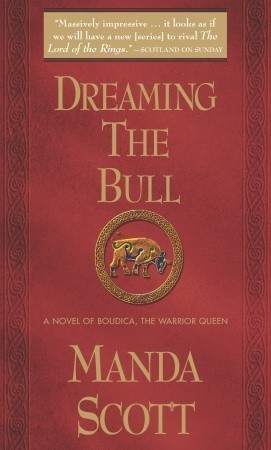
Book Review: BOUDICA: DREAMING THE BULL

As anticipated from my review of Boudica: Dreaming the Eagle by Manda Scott, I quickly picked up and pored through book two of this series.

I actually finished reading (listening to) Boudica: Dreaming the Bull at the end of May, but I’m just now getting around to posting my review.

Everything I loved about the first book – the writer’s elegant prose, the depth of historical world-building, the poignant interplay of the characters’ dialogue and gestures – carried through in book two.

While I missed spending as much time with Breaca as in the first novel, I was surprised and riveted by the stories of some of the other characters. The continued fall into darkness of Julius Velarius was not what I had looked forward to about this novel, but his chapters were compelling.

Scott did an excellent job showing how one can empathize with Julius, even when one disagrees with and even despises the choices he makes. His tragedy becomes the centerpiece for this book that still carries the reader through, without bogging them down in despair or anger. Those emotions are certainly felt, but they don’t hold back enjoyment of the wider story. Dubornos was another surprisingly interesting character in this novel.

This book was enjoyable overall. The consistency in writing style and attention to detail is a testament to Scott’s skill as a writer. As of this writing, I’m already 75% done with book three.

Steve D

Book Review: BOUDICA: DREAMING THE EAGLE and intricate narratives

Among my greatest literary addictions is historical fiction, especially that of pre-Norman Britain. Thus, it was only a matter of time before I came across, immediately bought, and read Boudica: Dreaming the Eagle, by Manda Scott.

This is the epic telling of Boudica, the Warrior Queen of the Celts who led the Celtic tribes of Britain against Rome’s second invasion in the first century BCE.

One of my favorite acknowledgments of this book is when Scott describes that very little – almost nothing, in fact – is actually known about who Boudica was, so most of the story of her life, her family, and the people whose lives she influenced are fictional.

Even still, this is a period in history that is so well-researched that the world comes to life from the very first chapter. Scott fully acknowledges the immensity of historical and archaeological resources and experts she leans on to construct this work. The payoff is a style of world-building and character-driven exposition that feels organic and does not overwhelm the reader yet completely envelops them.

The story generally follows the young Boudica – before she earns that title – and various members of her tribe as they prepare for the Roman legions to return to their shores. The characters’ connection to each other, through inter-tribal politics and vows of personal honor, drive the emotional weight of the story.

This book has brutal depictions of war, but Scott deftly works around the gory details to paint the tapestry of a battle from the perceptions of those involved. The reader can see the battle play out in their mind’s eye but does not need to be told about every stroke of a blade or every spurt of blood. The horrors of war are apparent without being gratuitous.

Scott’s narrative is incredibly detailed with not a single word or metaphor wasted. Her prose is elegant and precise, where dialogue between characters does not have to reveal every single thought in order to convey deep meaning.

This is flat out one of the best epic novels I’ve read. I’m already reading book two, Boudica: Dreaming the Bull.

Steve D

Book Review: A CLOSED AND COMMON ORBIT lands as cozy sci-fi with intimately personal stakes

After gulping down the audiobook form of The Long Way to a Small, Angry Planet, Becky Chambers’s first in the Wayfarer series, I did not hesitate to pick up book 2: A Closed and Common Orbit.

I had thoroughly enjoyed the first series entrant as a galaxy-crossing sci-fi adventure, so I was a caught a bit off guard to discover that I would spend all of book 2 with characters who were only a footnote in book 1.

Part of this is my fault, because I neglected to read the blurb before purchasing and beginning A Closed and Common Orbit. So I was a bit surprised, a little confused, and then curious.

This book follows Pepper, a tech whom the crew of The Wayfarer encounter in book 1, and Sidra, a conscious AI placed into a human-like body. Pepper’s and Sidra’s stories meshed well and approached themes of identity, predestination, and humanity with thoughtfulness. The two spend much of the book trying to navigate their own senses of self, while also figuring out how to integrate Sidra into Personhood and the local society of pepper’s home city.

Pepper’s story also looks backward, beginning with her life a child to explore how she got where she is. I was intrigued by Pepper’s hardships as a teenager, and I felt that her transition from that life into the one she built for herself was glossed over. However, her backstory clearly focused on and succeeded with explaining why she has such an affinity for advanced AI’s and their personhood.

Both character arcs are effective in demonstrating and resolving their respective emotional journeys.

Surrounding these very intimate themes of identity, the story barely touched on how Pepper’s and Sidra’s society did not accept AI’s as People, and what that might mean for Sidra. I would have liked to understand more about how technology and sapient AI was viewed and treated in the Galactic Commons at large.

Rich world-building surrounds this story, but it’s a little too focused on the characters’ internal struggles. I kept looking for a broader view to balance the intense personal stakes of the story. Similar to its predecessor, A Closed and Common Orbit excels in displaying what life is like for people on this planet, a sort of cozy sci-fi setting for these poignant themes.

Still, this was very much worth the read, and I’m interested in continuing this series in the near future.

For the audiobook, I found the narration stilted with unnatural inflection in many places, especially with dialogue. I think this may have been intentional by the narrator to reflect Sidra’s voice as an AI, but it honestly became more and more grating as the story proceeded.

Steve D

Book Review: THE LONG WAY TO A SMALL, ANGRY PLANET

I recently listened to the audiobook version of The Long Way to a Small, Angry Planet by Becky Chambers, a story I found delightful in its character-building, and intriguing in its world-building.

The Long Way to a Small, Angry Planet presents a vivid galaxy of unique species governed by the Galactic Commons. Humans in this story are among the least powerful species, their Exodans having survived the destruction of Earth (at human hands) and only recently invited as a GC member species. The Galactic Commons includes a diverse array of non-human species, each with their own cultures, histories, and perceptions about their galaxy and the other peoples within it.

Chambers is very deliberate the language she uses to describe each species and individual. While their physical traits and cultural norms may differ, all GC member species are People, and all are referred to as Sapient. Specific individuals are also male, female, or non-binary, with standard pronouns that appear to be widely accepted across the story for such designations. This helps acclimate the reader to each character’s voice and perspective, while making it seem plausible that they speak a common language (called Clip) and have relatable mannerisms and colloquial speech patterns.

Within this setting, Chambers explores a rich tapestry of relationships, inter-species politics, and grounded character struggles aboard a long-haul ship. Rosemary Harper, a human from the Mars settlement, is the lead protagonist, but she does not necessarily drive the narrative.

As the newest member of the Wayfarer crew, a long-haul tunneling ship which bores holes through the fabric of spacetime to create tunnels through which ships can jump light-years across the galaxy, Rosemary is an observer who becomes a more and more prominent member of the crew. She develops her own relationships with her crewmates and shows how her clerical and research skills can help their ship.

But Rosemary’s outsider status as a spacer means that her perspective is a suitable entry point for the reader into this world.

Chambers’s writing is funny and poignant, with realistic dialogue and good escalation amid more tense moments and scenes. Her character development would work in any setting, but the fact that she couples this with believable sci-fi world-building elevates the story into a compelling narrative.

This was a book I couldn’t put down, and would gladly read again.

I would likely purchase and read a hard copy, because the audiobook’s narrator made some interesting inflection and pronunciation choices that took me out of the story for scattered moments.

Steve D