Book Review: MCU illuminates the history of Marvel’s films

I recently listened to MCU: The Reign of Marvel Studios on audiobook. I heard about the book, because one of the co-authors, Joanna Robinson, has a podcast I frequently listen to (House of R), and she talked a bit about the book in the run-up to its release late last year.

I’ve enjoyed Marvel films over the years and admire what they had achieved through the Infinity Saga. I also really enjoy documentary-style storytelling with behind-the-scenes insights. This book excels at this type of storytelling.

With plenty of quotes and perspective from the people who were involved with these films over the decades, it’s clear that the authors spent tons of hours conducting interviews with all kinds of folks, from production assistants on 20-year-old films, to directors, set/costume/effects designers, to the major actors, to Kevin Feige himself. There are countless anecdotes about snap decisions made in one era of the studio’s history that directly shape how the movies came together years later.

The book is paced and structured like a documentary, with most chapters focusing on a particular film, or a particular piece of the MCU machine, such as visual effects. It begins in the very earliest days of Marvel’s forays into film and television in the 60s and 70s, with projects and people I had scarcely been aware of, and then really picks up in the early 2000s, when superhero films started appearing in greater numbers.

The authors did a good job balancing fair criticism of various parts of the studio’s process with genuine appreciation of its accomplishments. The chapters on The Infinity Saga are rightfully tinged with admiration at how those films were pulled off, while the chapter on visual effects speaks to the issues that VFX artists have faced in dealing with the tight deadlines, scant budgets, and long hours demanded by their contracts with Marvel Studios.

My one critique is that the closing sections felt a little too concise. If this is a history of the MCU – and it certainly reads like one – then I would have wanted a little more summation on this era of Marvel Studios and what the future looks like.

Still a great read, and definitely worth picking up again to absorb all the nuggets of information spread throughout.

Steve D

Book Review: BLACK LEOPARD, RED WOLF is a portal to an intricate world

A couple weeks ago I finished reading Black Leopard, Red Wolf, by Marlon James.

This book took me a while to get through in audiobook format.

I held out because I knew that a story as deep and emotionally resonant as this had to be going somewhere, and I was riveted by Dion Graham’s masterful narration. I’m ultimately glad I stuck with this one.

This is an unbelievably well-crafted story, characters, and world. Based on African myth and lore, it’s difficult to find an apt comparison in modern epic fantasy for this book. Because it doesn’t take from Western fantasy, it feels new and intimidating in a way I haven’t experienced for some time. The world itself is as unknown as the characters and the plot.

James writes with a ferocity of emotion that Graham only elevates with voice changes and ornamentations worthy of the greatest dramatic pieces. Black Leopard, Red Wolf has to be one of the best fantasy epics in recent memory.

My reading and understanding of it was lost during the first third of the story, where I found it difficult to understand what was happening and where the story was headed. It was extremely detailed, and kept jumping around in time between the protagonist, Tracker’s, early life, and his questioning by an inquisitor sometime in the future.

By the middle of the book, I had found the story’s rhythm, and by the final act, I was enraptured. At the moment, I can only recommend this as one of the best written fantasy novels I’ve read in a long time.

I intend to get the novel in hardcover to read it again. As for the sequel, Moon Witch, Spider King — I may just have to read both the hardcover and audio versions, to sink into James’s story and float away with Graham’s narration.

Steve D

On Why I Continue to Write

Existential dread for writing is real, as it probably is for any creative pursuit, honestly.

I often find myself asking “why” I write, why I continue to believe this is something I should be spending my time and energy on. This question doesn’t normally come as an emotional response, as in how can I go on writing? Who even wants to read my stories? It’s a matter of objective reasoning — existentialist — as in, what’s the use in writing if I’m not aggressively pursuing bestseller lists or millions of readers or international fame. Why am I persisting with this?

I think it’s easy to feel overwhelmed by the doubtful voices in your head, so arming yourself with a litany of reasons to keep writing can be helpful when those doubts start to creep in.

For me, in the current moment, the doubt stems not from a lack of desire to write, or even a lack of stories I feel I want to tell, but from the extremely limited time I can spend writing day-to-day, or week-to-week.

Even now, I write this blog post at 11pm, after one long day of work, on the cusp of another, when I should be in bed trying to capture the rest of which I am so often in want. My wife sleeps in our bed across the room from me, as does Teddy, our Jack Russell who loves nothing more than to curl up between us.

In this moment, I’m writing in spite of the things I should rather be spending my time on. At least, that’s what the doubtful voices in my are telling me.

Writing stories is a lot harder than writing blogs, and, as my monthly goals posts will attest, it has become even more difficult for me to find either the time or the mental space to write stories, of late.

So naturally, I’ve begun to question whether it’s worth the effort, the pressure I still put on myself to write.

My conclusion, for now, is that it is. When I was writing my first novel, I felt an urgent need to finish and publish that story. My goal at the time was to publish my first book before I turned 30, and I achieved that with less than two months to spare.

Now, I feel the need to continue to tell stories, but not on any particular timeline. So, for the current moment, I’m writing because I feel as though I should tell the stories in my head, for whoever ends up reading them.

What that means when it comes to publishing them, I’m not sure. They will be published, but the purpose and form of that is more nebulous than it used to be, and I’m okay with that. In some ways, the writing is the point, at least for right now.

Steve D

February Write Day: Resetting Expectations

January has been a full month. I’m taking an online noncredit course for work, and I had underestimated the amount of mental energy it would require from me, on top of my day job.

Last Month’s Goal

  1. Read three books.
  2. Exercise at least every other day and get back to the gym.
  3. Finish current round of revisions for New Earth.
  4. Outline New Earth for chapter structure.
  5. Begin revisions based on character notes.

Let’s get to the reviewing.

Read three books?

No. I finished one book in January, although I made progress on two others.

I sort of don’t know what to do with the current book I’m listening on audiobook: Black Leopard, Red Wolf. The world is more detailed than anything I’ve ever read. The characters are intimate and unique. And yet, one-third of the way through the book, I’m just starting to grasp where this story is headed. This book is 24 hours of listening time in audio format, and it’s taken me nearly eight hours to understand the plot.

Maybe audiobook is the wrong format to read this book. I intend to finish it, but I have been stalled by snail’s pace of a plot on this one. What kills me is that this is an incredibly well-written book. I really want to like it. So, I’m hoping it will start to pick up in the second act.

Exercise every other day and get back to the gym?

Almost. I exercised 11 days in January, but I did not make it to the gym. My challenge at the moment is finding the right time of day to work out, and making that part of my routine.

When I was last going to the gym regularly, about four years ago now, I had access to a really nice gym in the office where I worked. This allowed me to work out during my lunch breaks. Once I left that job, I had to reset my routine to work out in the evenings at a local gym.

When I stopped going to my local gym — circa 2020, no idea why… — I never went back. So now, I’m in this space where on any given day, I know I should exercise, but I find it difficult to a) tear myself away from work, even though I mostly work from home, b) tear myself away from family obligations in the evenings, or c) motivate to go to the gym later at night once the kids are in bed.

So, I’m still trying to find that balance. I think it may end up being a mixed bag of short workouts on weekday afternoons, and one or two longer gym workouts at night or on the weekends.

Finish current round of revisions for New Earth?

Technically, yes!

Because I never wrote an ending to this story, and somehow forgot about that fact. I need to finish the ending, and then I can call this done.

Outline this story for chapter structure, and revise based on character sheets?

No, and no. See above.

Goals for February

I have some catching up to do in February. My online course will continue through this month, so now that I know what the course load really looks like, I should be able to work around it better.

I started a new thing last week. Weekly goals for my personal life. I track weekly goals for work as a running to-do list, so I thought I might as well try that in my home life as well. I’m starting with pretty basic things, but being able to check things off throughout the week is good.

Incidentally, most of my personal weekly goals are related to my monthly goals. I don’t intend to publish them here regularly, but perhaps I’ll talk about them now and then.

The point is, I’m hoping this will help me stay focused on the things that are important to me, sort of a self-care checklist.

  1. Read 3 books. I’m actually not sure how I’m going to achieve this in February. I will likely not finish Black Leopard, Red Wolf this month, unless it becomes extremely compelling soon. I can probably finish my current nonfiction paperback read, and I may need to find a couple of shorter reads to fill the gaps in between.
  2. Exercise every other day and get to the gym. Same as last month, just trying to establish that routine.
  3. Finish ending for New Earth. I know how I want to tie off this story. I just need to sit down and do it. I’m honestly out of practice for long writing sessions, what with my focus on revisions this past year.
  4. Outline New Earth for chapter structure. Same.

Steve D

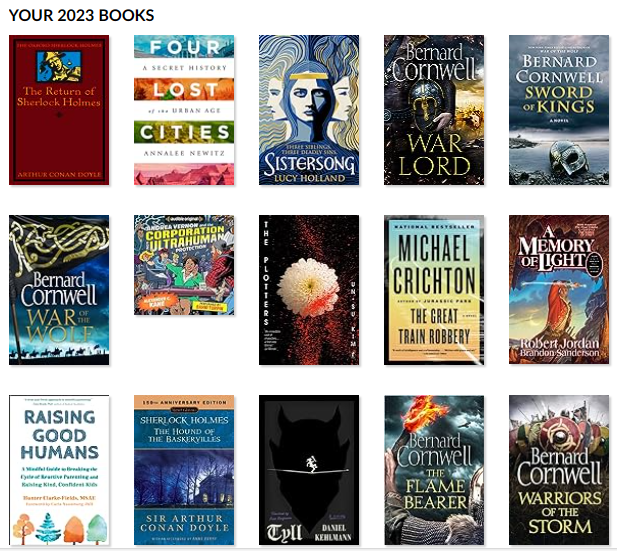
My Goodreads Challenge 2023 Recap

Around this time of year, I usually do a bunch of recaps on my goals, my website stats, or my book publishing strategy for the upcoming year. I’m not doing any of that this year, because I like my monthly goal recaps, my website stats are underwhelming and not a key focus for me, and I’m still figuring out my next steps for publishing, as opposed to just writing.

One thing I am pretty stoked about from 2023, however, is my Goodreads reading challenge, in which I achieved my goal of 26 books read for 2023.

The Highlights

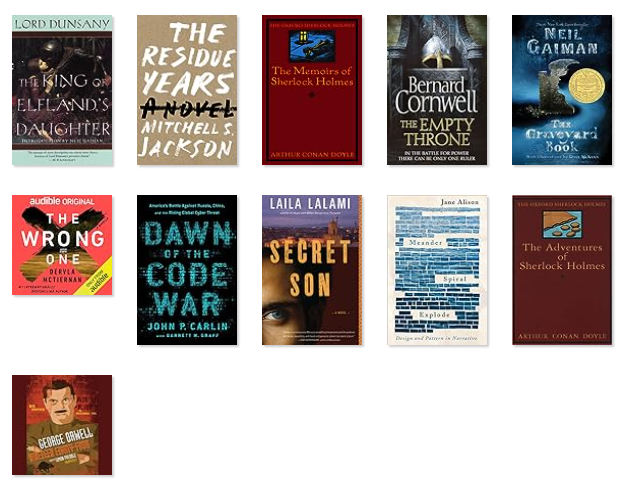
I’m not going to list each and every book; you can check out the detail above or on my Goodreads profile if you like. But it’s fund to look at my reading trend/mood for the last year.

I read…

22 fiction books, including…

  • 6 novels from The Last Kingdom series, which I finished in 2023
  • 4 collections of Sir Arthur Conan Doyle’s Sherlock Holmes stories
  • 1 finale to The Wheel of Time
  • 5 other fantasy stories
  • 4 thrillers
  • 2 character dramas

4 nonfiction books, including…

  • 2 history books, usually a staple of my reading list
  • 1 parenting book
  • 1 book about writing

I didn’t really read any sci fi this year, but I did read a lot of historical fiction, as opposed to fantasy or just straight history. I’d like to continue reading historical fiction this year; the challenge is finding the books with the right balance of historical basis, fictionalization, and overall storytelling.

Anyway, I like that spread, but will probably try to read a bit more nonfiction and sci-fi this year, just to diversify a bit more. I’m also not sure whether or which type of super-epic fiction series I might get into this year. I haven’t yet identified a series that might dominate my reading list across the year, but we’ll see, of course.

Steve D

Creativity Sessions writing process. Evening Satellite Publishing.

Character Sheet Template: My POV Character’s Details

Earlier the month, I discussed my current task to create character sheets for the main characters in my duology of novellas, Uprooted and New Earth. My goal with these is to fill out the flourishes of detail that I skimmed over when first writing these stories, to ensure my characters feel distinct from each other and can each be described consistently.

In that previous post, I listed what I thought would be useful details for me to pin down for each of my main characters. Because these stories deal with family trauma for a clan of extended family, there are a lot of characters. Not all of them will be as fleshed out as others, because some are more side characters.

What I ended up doing was using a basic character template for each member of the clan, and then trimmed it down based on how frequent or significant that character’s appearances are throughout the stories.

For today, I wanted to share the full character template for my primary, point-of-view character: Mikaela.

Character Sheet: Mikaela

Logline: “After her village is attacked, a woman must do everything she can to protect her family.”

Age: 29

Occupation/role: Herbalist and healer; Married to the clan leader with two children; caretaker for her mother-in-law

Physical: I actually don’t have a great description of Mikaela’s physical appearance, because she’s the POV character – it would be odd for her to describe herself, but I should be able to work in a few details naturally, such as the texture/length of her hair.

Clothing: A dagger made from a particular type of stone she wears around her neck tied with a leather cord. This was given to her by her husband as a wedding gift. This type of stone is rare, so this is a precious gift both in its value and its utility for Mikaela as an herbalist.

  • I’d also like to add one or two small details about the clothes Mikaela wears, so I will need to include those in my stories.

How Mikaela…

Thinks/feels about her life in her village: Mikaela likes her village, loves her clan relatives, and especially her clan-sisters, and believes they have everything they need to raise their children. She wishes she had some connection to her mother other than the herbalism Mikaela learned from her. She has not seen her own parents since she was married off to her husband and left the village she grew up in.

Gestures: sighs of exasperation; bites her bottom lip when deep in thought or anxious

What she wants: to raise her son to be a kind man like his father; to raise her daughter to be resilient and to pass her knowledge of herbs and healing onto her

What motivates her: Providing for her children and the rest of their family

What she fears: losing her family – Her husband or son getting killed in the hunt or a raid, her daughter being married off to a different village, never to see her mother again

Filling in the Gaps

As you can see, I have a couple of gaps to fill in for Mikaela’s character sheet, particularly in her clothing and appearance. Because she’s my main character, I wanted her character sheet to be the most detailed, but most of this information came naturally as I was writing.

I will not be going into this level of detail for every character. Even the four or five primary characters around Mikaela will not have this much detail, and the secondary and tertiary characters even less.

In any case, I’m looking forward to completing these and filling in the gaps in my writing as part of my ongoing revision process.

Let me know what you think. Would you take a different approach to character sheets?

Steve D

Creativity Sessions writing process. Evening Satellite Publishing.

My Character Sheet Template

One of my goals for this month is to create character sheets for the main characters in my duology, Uprooted and New Earth. I’ve already gone through multiple drafts and revisions for each of these novellas, so why am I doing character sheets now?

Because I didn’t do them initially, and my early drafts of these stories were heavily focused on plot and dialogue, rather than characters. Going into writing Uprooted, the first of this duology, I had a basic idea of who my characters were and how the plot would unfold with them, but not much else. I was focused more on telling the story rather than adding the flourishes of detail that make it feel alive.

Now, I want to go back and make sure that living detail comes off the page. These stories are snapshots of a family dealing with trauma — there are a lot of names and a lot of moving pieces. So, I want the main characters to feel distinct, each with their own expressions, clothes, gestures, and opinions.

I also don’t want to entirely rewrite my story around these details, so I need to work backwards a little bit. I’ll design my character sheet templates, fill in whatever information I already have for each character from what’s already written, and then fill in the blanks.

You can find tons of character sheet templates online, so I’m creating one that fits my fairly specific purpose of retrofitting some details onto established characters. Here’s where I’ll start.

Character Sheet Template

  • The basics: Name, age, role in the family/clan (family roles are vital in these stories)
  • Logline: Something I always write for my major characters — the single sentence that captures what the character is trying to achieve and what stands in their way.
  • Physical description: the details missing for a lot of my characters. I’ll likely stick to 2-4 simple details, such as distinct facial features or posture.
  • Clothing: This family is from a small village, so their dress won’t differ too much. What can standout: head scarves. Children in this society wear particular styles of headscarves until they come of age. Adults then wear these headscarves differently, depending on their role in the family. This is a crucial detail that I want to ensure feels authentic.
  • Personality: How the characters thinks, feels, reacts.
  • What the character wants
  • What the character fears

I could probably go into even more depth, but I don’t want to overload myself for this month. I’m not even sure how many characters I will ultimately create sheets for – likely six, at the least. Perhaps I can create full character sheets for my mains, and slimmed-down versions for more side characters.

I’ll see how much effort this takes me, and, I just may share a couple of the characters’ details later on.

Steve D

LOKI Season 2 Bookends the Best of Recent MCU Stories

I’m a couple of weeks late writing this post, because I did not watch Loki season 2 as it was released on DIsney+. I mostly watched over the last two weeks, and then binged both episodes five and six last week.

Since then, I’ve been mulling over the season (and series?) finale while listening to a couple of my favorite podcasts’ coverage of the show. And I’ve come to a simple conclusion.

Loki is the best story that the MCU has told since Avengers: Endgame.

I will not spoil this show, just as I try not to spoil books I read and review. But through 12 episodes and two seasons of television, the titular character follows an arc that must be compared with similar heavyweight arcs of Thor or Iron Man in the Infinity Saga.

Loki enters season one as a villain, freshly time-jumped from the end of Avengers, when he tried to invade New York City with an interdimensional alien army. Through his experiences at the Time Variance Authority and witnessing other timelines — other pasts and possible futures — Loki changes and evolves into something other than the conquering Asgardian god of mischief.

I have been mostly underwhelmed and occasionally disappointed with the MCU TV shows over the last few years. They have primarily felt like movies that were stretched too thin or longer television seasons that were crammed into tighter spaces, with no obvious direction to point towards in terms of building a story around the next big villain.

Loki, the character, is not that next big villain, but Loki, the show takes Big Villain Stakes that most of the recent MCU properties have been missing, and boils them down to emotional, dramatic storytelling between characters.

And the climactic finale, rather than being a CGI punch-fest, is a stunning and spectacular moment of agency for one character to choose his path.

The series ends so resolutely, so satisfyingly, that Marvel could end the series, put a period on Loki’s character journey, and I would be content. If nothing else, I can go read the comic run that inspired this show.

However Marvel came to execute Loki as a storytelling vision, I hope they follow a similar path for TV and movies going forward.

Steve D

On FOUR LOST CITIES and Building this Fantasy Town

This post is not a real book review, at least, not entirely. I just finished listening to Four Lost Cities: A Secret History of the Urban Age by Annalee Newitz, and it got me thinking and rethinking the way I design and evolve cities in my fantasy universe.

A running theme in my world-building — and one of my pervading interests in history and anthropology — touches on the rise and fall of cities and civilizations. For years, I had the reductionist viewpoint that great cities rose and fell in linear patterns, and with clear markers for their demise.

When I learned that the far more common pattern is for cities (or civilizations) decay for years or decades or centuries before fading from prominence, I wanted to explore that in my storytelling.

Four Lost Cities provides a really interesting investigation into the formation and decline of cities across human history. Newitz uses archeological evidence to make the case that the evolution and dissolution of cities is not a linear path, that the very definition of a “city” and its growth are defined more by socio-cultural forces of its time than by rigid and often arbitrary models based solely on commerce.

What would this look like in a setting of my making? Would I be able to capture the uncertain rise and long decay of a city or a people in character-centric stories?

My current work-in-progress, the duology I’ve been referring to as The Herb Witch Tales, spawned from this theme. Before I knew who my characters were, I wanted to explore a city’s evolution from small port town, to sprawling tent camp of migrant settlers, to developed population center.

The story developed from the idea of the city, and I found characters to fit that initial blueprint. The duology is now much more grounded than that much broader idea, but I’ve tried to pay particular attention to the ways in which the characters perceive and interact with place — the places they’ve lost, left, or found.

Although The Herb Witch Tales is currently a duology, I can easily imagine future stories where the growth of this family is inextricably tied with the growth of the place they come to call home.

So, I must recommend Four Lost Cities, because it is informative, thought-provoking, and inspiring in a world-building kind of way.

Steve D