Book Review: BLACKFISH CITY and the scarily real imaginings of our post-apocalyptic future

I’m way behind on posting this. Last month, I finished listening to Blackfish City by Sam J. Miller in audiobook.

This book had jumped out to me both for its stunning cover — cyberpunk feel with Indigenous artistic themes — and its intriguing synopsis.

Miller constructs a fascinating future world where refugees and oligarchs have fled or abandoned their fallen cities due to climate disasters. Miller deftly alludes to a multitude of climate disasters causing upheaval around the world, but really only goes into detail in one instance, as it affected a few of the characters.

Many of these refugees fled their homes for a newly built city in the Arctic Circle — an eight-armed floating city called Qaanaaq. The design of Qaanaaq is intricate and authentic. Miller describes geothermal pipes used to warm the entire city, and a highly computerized system that mostly runs the underlying infrastructure needs of the entire city.

Qaanaaq feels like a place that could very easily exist in a post-climate disaster world, both exploitative of the people who’ve lost everything and serving those who have profited from the chaos of a crumbling global civilization. It is technologically advanced and still not free of poverty, overcrowding, resource scarcity, and bureaucratic ignorance of real people’s issues that plagues rapidly growing cities.

I found it difficult to connect with the characters at first. I couldn’t quite place the age of most of the characters until much later int he story, so I assumed they were all Adults — this was not the case. Miller’s brilliance is in the way he slowly weaves interconnectedness between the characters, but this also requires patience from the reader to allow those connections and the wider story to unfold.

Fortunately, the world-building is what really kept me invested. Once some of the plot began to reveal itself, the pacing picked up, and I began to understand the wider narrative better.

This was a highly enjoyable story, and Miller is a fantastic writer. I genuinely hope to return to this world in future stories.

Steve D

Book Review: AMONG THE BEASTS AND BRIARS

I discovered this book somewhere on Audible and gave it a listen a few weeks ago. (I’m a bit behind on posting my book reviews.)

Among the Beasts and Briars by Ashley Poston is an enjoyable story about gardener’s daughter, Cerys, who is cursed with the magic of the dark forest that borders her home, and who must save her kingdom from the forest’s dark powers.

This was a classic quest/coming-of-age story with a strong underpinning of fairy tale lore – the dark forest, old gods, terrible curses, and young people reaping the sins of their forebears. There is a spot of romance throughout the narrative as well, but I would not describe this as a romance novel — it fits well with the plot. The story is well-paced, and there are enough little twists to keep the reader guessing as to the final resolution.

There is some surprisingly fantastical and frightening imagery as the characters survive and then confront the dark magic of the forest, and I think this story would translate well to an animated horror/fantasy treatment.

For the audiobook version, male and female narrators trade point-of-view sections for the two characters who end up becoming our protagonists. The dual narrators definitely provided interesting perspective, as the conflicted perspectives of particular scenes drove some of the conflict. However, I didn’t find that the narrators’ voices matched what I felt were much more intense or frightening scenes, especially in places where Cerys confronts gaunt and terrible visages of the people of her kingdom. I think there’s a version of this narration that could lean much more heavily into the horror aspects.

Still, this was an enjoyable standalone novel, and I’m curious about of Poston’s other work.

Steve D

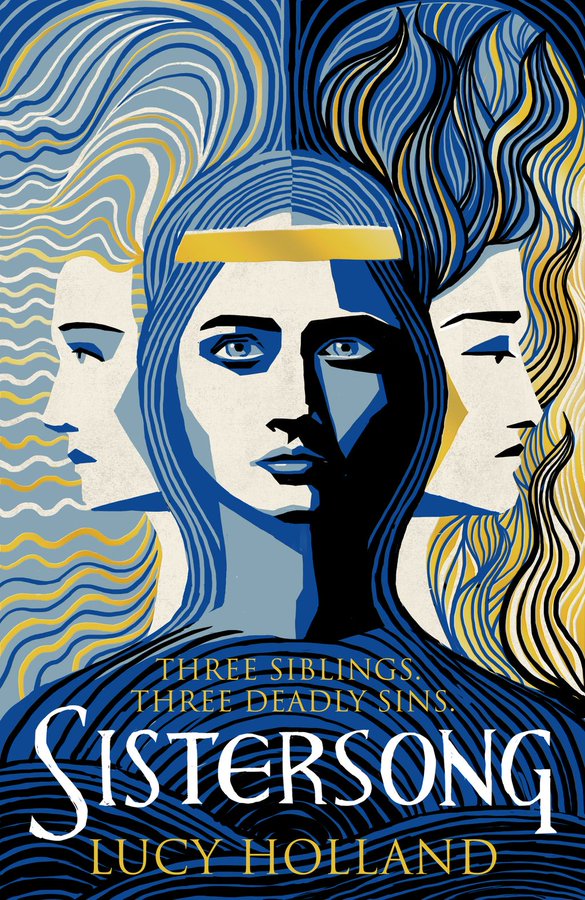
Book Review: SISTERSONG reignites old magic in Dark Age Britain

I recently listened to Sistersong by Lucy Holland on audiobook. I’m in the midst of an era kick, where I’m almost exclusively interested in historical fiction or fiction stories set in Dark Age Britain. So, I found this book as part of my keyword search on Audible, and it sounded intriguing.

I enjoyed it, overall.

This was a very intricately and well written story. Holland deftly weaves part fairy tale, part ballad about the stories we tell ourselves and how they come to define us. This story follows three siblings who are each struggling to understand or reconcile some part of themselves, or, in my ways, some part of their relationships with their parents and with each other.

Thus, the story quickly becomes part family reckoning, part coming-of-age, and part classical drama, all wrapped in a tale of lost magic and impending war.

Having known nothing so this story or author beforehand, I found it both surprising and familiar, in the way that classical storytelling forms often are. I recognized the beats as they came, but the characters’ lives were so vivid that their inner emotional turmoil drove the tension.

Each of the three siblings at the center of Sistersong has a unique voice that reflects the others, making their interactions poignant in every scene. Holland peppers her story with enough twists and interesting character turns to make it feel unique.

The soft magic system felt a bit all-powerful for my liking, but it was not a ‘deus ex machina’ effect. Magic permeated the narrative, but did not drive it completely.

Steve D

Book Review: THE GRAVEYARD BOOK tugs at adult children’s heartstrings

Another wonderful modern fairytale by Neil Gaiman. At this point, I have no excuse whatsoever for not poring through every single story that Gaiman has ever written, because each story feels impactful and poignant.

I listened to the full-cast production of The Graveyard Book on Audible. I’m used to Gaiman narrating his own stories and being a fantastic storyteller. The full-cast production of The Graveyard Book is stellar; each voice actor brings nuance and feeling to their character(s), and the voicing brings real life to the scenes in a way I normally do not expect from audiobooks.

This story follows a boy who was raised in a graveyard after his family were murdered when he was a toddler, and eventually learns how to survive in the world outside. The boy, Bod, short for Nobody Owens, also must ultimately learn about the man who killed his family.

Gaiman writes primarily from the boy’s perspective, and Bod’s narrative voice grows naturally as he ages, a credit to Gaiman’s writing, and the voice actor’s work. Bod develops a close if curious relationship with his guardian, a not-quite-human-being named Silas who has an uncanny ability to fade into the shadows. Silas does not express the usual paternal emotions for his charge, but throughout the book, the emotional bond Bod has with Silas, and the other residents of his graveyard, are unshakable.

Yet again, Gaiman masterfully inserts pieces of folklore into his story to make it feel supernatural and mysterious and familiar all at once.

This is the third Neil Gaiman story I’ve read, and he is quickly bounding to the top of my favorite authors list. I cannot rave about this story enough, so I’ll stop myself before this gets out of hand.

Steve D

Book Review: EXIT WEST and relatable worlds

Exit West has been in my Audible library for at least over a year — when Audible used to make their Originals content available as part of a monthly selection.

I picked it up and sort of forgot about it, buried at the bottom of my Not Started list. I finally decided to give it a shot.

I ended up enjoying Exit West much more than I had anticipated when I first started. Mohsin Hamid’s narrative starts off slowly, the first couple chapters introducing the protagonists, Saeed and Nadia, in terms of their relationships, families, and how they were raised in a predominantly conservative Muslim society.

What’s interesting is that Hamid never names the country in which Saeed and Nadia live, and the particulars of the political conflict that upends their lives is inconsequential. Hamid chooses to focus on how it impacts them to tell a story that could apply to any two people, from any society, at any time in human history.

This is reinforced in the structure of the story. Hamid uses a methodical narrative style to capture vignettes of the lives of his characters. He then extends this to nameless characters we meet only once, snapshots of people’s lives who on the surface have no relation to the protagonists but whose shared experiences enliven the story.

Hamid presents a fictional future that likely already exists in some countries and will be more widespread over the coming decades. As the political conflict quickly turns to civil war around them, Saeed and Nadia are forced to hide out in their own homes before making the heart-wrenching decision to escape through one of the many doors that transports people from one life to another.

This is a world in which human societies are more divided but also more interconnected, where large groups of migrants have to eke out their existence in new places, fundamentally reshaping the identity of the places they come to inhabit, as well as themselves.

Saeed and Nadia try to hold their fraying relationship together among this emotional tumult, and their bond becomes the strongest force holding the narrative itself together.

Speaking of the audiobook version, Hamid’s narration is steady, and emotional notes come not in his inflection, but in the meaning and rhythm of his words.

I’m pleased to find two other stories by Hamid available on Audible, and regret not listening to him sooner.

Steve D