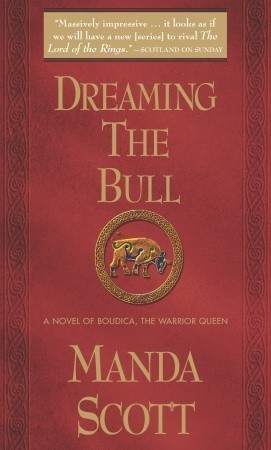
Book Review: BOUDICA: DREAMING THE BULL

As anticipated from my review of Boudica: Dreaming the Eagle by Manda Scott, I quickly picked up and pored through book two of this series.

I actually finished reading (listening to) Boudica: Dreaming the Bull at the end of May, but I’m just now getting around to posting my review.

Everything I loved about the first book – the writer’s elegant prose, the depth of historical world-building, the poignant interplay of the characters’ dialogue and gestures – carried through in book two.

While I missed spending as much time with Breaca as in the first novel, I was surprised and riveted by the stories of some of the other characters. The continued fall into darkness of Julius Velarius was not what I had looked forward to about this novel, but his chapters were compelling.

Scott did an excellent job showing how one can empathize with Julius, even when one disagrees with and even despises the choices he makes. His tragedy becomes the centerpiece for this book that still carries the reader through, without bogging them down in despair or anger. Those emotions are certainly felt, but they don’t hold back enjoyment of the wider story. Dubornos was another surprisingly interesting character in this novel.

This book was enjoyable overall. The consistency in writing style and attention to detail is a testament to Scott’s skill as a writer. As of this writing, I’m already 75% done with book three.

Steve D

Book Review: BOUDICA: DREAMING THE EAGLE and intricate narratives

Among my greatest literary addictions is historical fiction, especially that of pre-Norman Britain. Thus, it was only a matter of time before I came across, immediately bought, and read Boudica: Dreaming the Eagle, by Manda Scott.

This is the epic telling of Boudica, the Warrior Queen of the Celts who led the Celtic tribes of Britain against Rome’s second invasion in the first century BCE.

One of my favorite acknowledgments of this book is when Scott describes that very little – almost nothing, in fact – is actually known about who Boudica was, so most of the story of her life, her family, and the people whose lives she influenced are fictional.

Even still, this is a period in history that is so well-researched that the world comes to life from the very first chapter. Scott fully acknowledges the immensity of historical and archaeological resources and experts she leans on to construct this work. The payoff is a style of world-building and character-driven exposition that feels organic and does not overwhelm the reader yet completely envelops them.

The story generally follows the young Boudica – before she earns that title – and various members of her tribe as they prepare for the Roman legions to return to their shores. The characters’ connection to each other, through inter-tribal politics and vows of personal honor, drive the emotional weight of the story.

This book has brutal depictions of war, but Scott deftly works around the gory details to paint the tapestry of a battle from the perceptions of those involved. The reader can see the battle play out in their mind’s eye but does not need to be told about every stroke of a blade or every spurt of blood. The horrors of war are apparent without being gratuitous.

Scott’s narrative is incredibly detailed with not a single word or metaphor wasted. Her prose is elegant and precise, where dialogue between characters does not have to reveal every single thought in order to convey deep meaning.

This is flat out one of the best epic novels I’ve read. I’m already reading book two, Boudica: Dreaming the Bull.

Steve D

Book Review: DAUGHTER OF BLACK LAKE brings family drama to the Iron Age

I listened to Daughter of Black Lake by Cathy Marie Buchanan recently and quite enjoyed it.

I was drawn to this story mostly by the setting, the concept of a fiction set in Iron Age Britain. Daughter of Black Lake is not a military story of Romans and druids and seething tribesmen, although these devices make their appearances throughout the story. Instead, this is essentially a family drama that switches point of view between a daughter and her mother as a girl, whose lives and those of the people of their village are intertwined across generations.

This POV switching feels unexpected at first, but you quickly settle into the differing viewpoints between Hobble and her mother, Devout, even though Devout is narrating a decade or more in the past.

They each tell their versions of events impacting their family, with Hobble able to “see” more than most people know. She is gifted as a seer.

The story follows them both as Devout comes to find love and choose her mate, and as Hobble learns the dangers that outside influences can have on her quiet village of bog-dwellers. This back-and-forth narrative is a really interesting way to see characters interact across generations, first as children and adolescents interacting with each other or their elders, and then as adults, trying their best to help their families and their village survive.

The setting is vivid with pre-Roman and pre-Christian rites, prayers, social structures, and behaviors that guide each character’s decisions. These traditions are then thrown into conflict with the encroachment of Roman soldiers into the region, whose very presence, though distant, hangs over the bog-dwellers as an ominous threat to their way of life.

Although I typically don’t get into village drama-style narratives, I enjoyed the story for what it was. The characters were well written and distinguished, and the story was compelling. Mostly, I just wanted to spend time in the boggy village of Black Lake. Buchanan’s description give just enough detail to paint a clear picture, and her world felt entirely accurate, even as an astute reader questions how much we really know about the traditions and beliefs of pre-Roman Britons.

I would definitely pick up another book by Buchanan set in the same era, regardless of the plot, just to be able to step back into this world.

Steve D