Book Review: THE MAP OF SALT AND STARS

I’ve had The Map of Salt and Stars by Zeyn Joukhadar in my Audible library for several months, and I finally got around to listening to it. This is one of those books that, despite the blurb, I wasn’t quite sure what to expect from it.

I was pleasantly surprised.

The Map of Salt and Stars is a powerful story of struggle, sorrow, hope, and love. The story follows Nour, a young girl whose family is forced out of their home in Homs, Syria by the outbreak of the civil war, and Rawiya, a tenacious girl centuries earlier who embarks on a journey across the Mediterranean.

The mirrored stories of Rawiya and Nour created a beautiful symmetry in the plot while deriving meaning from both. Nour, in trying to understand what is happening to her family, and through the grief of lost loved ones, discovers the true meaning of her family’s history, and what it means to find home after everything she knows is destroyed. Meanwhile, Rawiya, in becoming a mapmaker’s apprentice, finds the adventure she’d been seeking, and reveals her own power as a brave warrior and cunning tactician.

The characters’ journeys follow each other from one end of the Mediterranean to the other. This structure makes the overall narrative familiar, but the twists and turns that take each character from one location to the next propel the plot forward from chapter to chapter.

The very real circumstances around Nour’s family — war, hunger, a refugee crisis in the making — are contrasted well by the more fantastical dangers of Rawiya’s journey fraught with dashing princes, mythical creatures, and magical stones.

Zeyn Joukhadar is an emotive writer, whose prose was thoughtful and intricate without being overly embellished.

The audio version was fantastic, but I think this is a story worth reading on the page. This is definitely a candidate to buy in hard cover for the home bookshelf.

Steve D

Book Review: BOUDICA: DREAMING THE HOUND

As expected from my earlier goals post, I finished Boudica: Dreaming the Hound, the third book of this series by Manda Scott, and am well on my way with the fourth.

I’ve already reviewed books one and two.

As book three of a four-book series, it was not too surprising to find that Dreaming the Hound had a minor case of middle book syndrome. The plot dragged a bit more than its predecessors, and both the characters and the reader are left waiting for momentous changes to happen: the Roman invasion of Mona, for instance.

Even still, there was some interesting character development in this story, particularly for Valerius and Cunomar. Valerius steps into his redemption arc, while Cunomar finally takes some initiative to become the warrior for which he has always overreached.

The ending of Breaca’s time with the Eceni, under Roman rule, comes swiftly and shockingly. I will spare the details, but the confrontational sequence towards the end of this arc is brutal and traumatic. Its purpose in the story is to portray what little historical evidence there exists for these events, as explained by Scott in the afterword. In the moment, though, it left a poor feeling.

I am still definitely enjoying this series overall, but I was somewhat relieved for this book to be over. Given Scott’s deft plot development and skilled character building, I was also optimistic to begin the fourth and final installment. That optimism has already paid off, and I’m greatly looking forward to seeing how this epic series ends.

Steve D

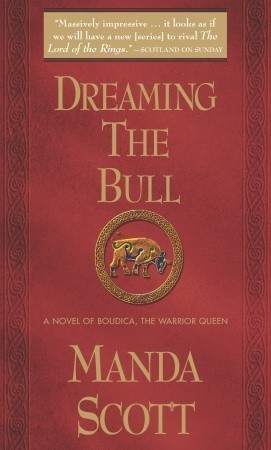
Book Review: BOUDICA: DREAMING THE BULL

As anticipated from my review of Boudica: Dreaming the Eagle by Manda Scott, I quickly picked up and pored through book two of this series.

I actually finished reading (listening to) Boudica: Dreaming the Bull at the end of May, but I’m just now getting around to posting my review.

Everything I loved about the first book – the writer’s elegant prose, the depth of historical world-building, the poignant interplay of the characters’ dialogue and gestures – carried through in book two.

While I missed spending as much time with Breaca as in the first novel, I was surprised and riveted by the stories of some of the other characters. The continued fall into darkness of Julius Velarius was not what I had looked forward to about this novel, but his chapters were compelling.

Scott did an excellent job showing how one can empathize with Julius, even when one disagrees with and even despises the choices he makes. His tragedy becomes the centerpiece for this book that still carries the reader through, without bogging them down in despair or anger. Those emotions are certainly felt, but they don’t hold back enjoyment of the wider story. Dubornos was another surprisingly interesting character in this novel.

This book was enjoyable overall. The consistency in writing style and attention to detail is a testament to Scott’s skill as a writer. As of this writing, I’m already 75% done with book three.

Steve D

Book Review: BOUDICA: DREAMING THE EAGLE and intricate narratives

Among my greatest literary addictions is historical fiction, especially that of pre-Norman Britain. Thus, it was only a matter of time before I came across, immediately bought, and read Boudica: Dreaming the Eagle, by Manda Scott.

This is the epic telling of Boudica, the Warrior Queen of the Celts who led the Celtic tribes of Britain against Rome’s second invasion in the first century BCE.

One of my favorite acknowledgments of this book is when Scott describes that very little – almost nothing, in fact – is actually known about who Boudica was, so most of the story of her life, her family, and the people whose lives she influenced are fictional.

Even still, this is a period in history that is so well-researched that the world comes to life from the very first chapter. Scott fully acknowledges the immensity of historical and archaeological resources and experts she leans on to construct this work. The payoff is a style of world-building and character-driven exposition that feels organic and does not overwhelm the reader yet completely envelops them.

The story generally follows the young Boudica – before she earns that title – and various members of her tribe as they prepare for the Roman legions to return to their shores. The characters’ connection to each other, through inter-tribal politics and vows of personal honor, drive the emotional weight of the story.

This book has brutal depictions of war, but Scott deftly works around the gory details to paint the tapestry of a battle from the perceptions of those involved. The reader can see the battle play out in their mind’s eye but does not need to be told about every stroke of a blade or every spurt of blood. The horrors of war are apparent without being gratuitous.

Scott’s narrative is incredibly detailed with not a single word or metaphor wasted. Her prose is elegant and precise, where dialogue between characters does not have to reveal every single thought in order to convey deep meaning.

This is flat out one of the best epic novels I’ve read. I’m already reading book two, Boudica: Dreaming the Bull.

Steve D

Book Review: A CURSE OF KRAKENS lands the trilogy masterfully

A Curse of Krakens is the third and final installment of Kevin Hearne’s The Seven Kennings series, which I rounded out fairly quickly on the heels of A Plague of Giants and A Blight of Blackwings.

A Curse of Krakens is a fantastic finale to the Seven Kennings trilogy. Oddly enough, I feel like I don’t have much to say about this specific book, because it so wonderfully builds upon the themes and characters of the first two novels and brings them to a fulfilling conclusion (alongside some exciting climactic moments, of course).

As a finale, this story expertly builds upon the narratives of its predecessors while elevating the story’s themes to a fulfilling ending. The pervading themes of grief, loss, and the characters’ ability to pick up the pieces and strive for a better future, both as individuals and as a collective, ring true to the end of the story. In fact, that eagerness to build something better from the rubble is exactly where this story lands.

I could see a scenario where a reader may find this overarching theme too “preachy”, but I find the optimistic, hopeful ethos of this world to be refreshing in a genre that is so often dominated by grim characters and grimmer worlds. I can’t think of a single thread from this sprawling story that was left untied by the book’s end. A Curse of Krakens really is the most fitting end to this series I can imagine.

Steve D


Book Review: A BLIGHT OF BLACKWINGS leaps above middle book syndrome

A Blight of Blackwings is the second installment of Kevin Hearne’s The Seven Kennings series, and I could not resist diving straight into it after I finished A Plague of Giants a few weeks back.

As with the first book, I greatly enjoyed A Blight of Blackwings, which felt somewhat different from its predecessor and deftly maneuvered around the dreaded middle book syndrome.

Hearne achieved this by lacing this book with its own somewhat contained narrative threads that appeared separate from the larger series plot. The introduction of characters like Pen, Hanima, and Koesha enriched the plot without making the reader feel over-burdened with new voices. After being given the proper time to develop in their own right, each new character ended up serving the larger narrative in their own ways, without becoming subsumed by it.

Where some middle books, especially in trilogies, struggle to maintain narrative momentum, Hearne provides tangible story progression that is not wholly divorced from the wider series, so the reader does not feel like they are just getting “filler” content before the finale.

Hearne also manages to hit similar emotional stakes in this book as the first. Grief, and the myriad ways in which characters process their grief, is a significant and explicit theme in the first book. Grief and loss play just as important a role in Blackwings, but in a much different way.

Where the first book used dramatic scenes to demonstrate the power of grief – and anger, and sorrow, and despair – Blackwings focuses this poignancy on smaller, more intimate scenes that deepen the reader’s connections with the characters.

In short, A Blight of Blackwings both inherits and expands upon its predecessor’s themes, creating a story that builds upon the series without feeling repetitive.

I’ve already started book three.

Steve D

January Write Day: Continue Down the Path

December was crazy, as should have been expected. We had a great holiday season, even if it was busier than we intended. I’m also coming into January busier than intended – new hire at work, new class starting this week, new projects to work on at home…

It already feels like a lot, so I’m just trying to stay focused on what’s in front of me each day.

Last Month’s Goals

  1. Read three books.
  2. Exercise at least every other day and go to the gym more than once per week.
  3. Finish current round of revisions for New Earth.
  4. Create character sheets with physical descriptions/clothes for main characters.
  5. Outline New Earth for chapter structure.

Ahhhh, the optimism of a new month. Let’s get this over with.

Read three books?

I finished one book and made some headway on two others. We had busy weekends leading up to the holidays, and I generally don’t bore my family with my audiobook choices in the car, unless they’re all asleep.

I’ve taken an unintended hiatus from Black Leopard, Red Wolf. I’m enjoying the story, and it feels like it’s really moving now after several chapters of… prelude? It’s just an incredibly heavy book, in tone, style, content, and detail. This is not the type of book I can zone out for, so I’m only inclined to listen to it when I can really focus.

I still managed to achieve my GoodReads challenge of reading 26 books, and I feel like I can do more. I’m aiming for 30 in 2024. I’ll also do a recap of my GoodReads list for 2023 this month.

Exercise and go to the gym?

Not really. A little bit. I only went to the gym once, and I did just enough yoga at home to not feel like total crap. The holiday season has always been tough for me maintaining an exercise routine, because of travel, and because of my desire to be lazy and cozy at home.

Finish current revisions?

Not quite. I had a little bit more to complete in New Earth than I had anticipated, and I was also lazy in December. I’m nearly done, though, and I’m still really enjoying the way this story has turned out. More revision phases will be needed, but it’s coming together.

Create character sheets?

In a way. Rather than creating individual documents or sections for each character, I used an existing reference. I had laid out a basic family tree for the clan at the center of my story in a spreadsheet. Each character’s role in the clan is absolutely a part of their characters, so it made sense to use that format as the basis for character sheets. Each character has their own cell in the spreadsheet, so I just added a note to each cell. The information is readily accessible, but it doesn’t take a lot of time for me to sift through.

I created the character sheet template for each character and filled out the details I knew offhand. What I now need to do is find references to other character details in my stories, record them in the character notes, and then do another round of revisions for those (and other) details across both stories.

Outline New Earth for chapter structure?

Nope. I’ll aim to do this after I finish this round of revisions.

Goals for January

  1. Read three books.
  2. Exercise at least every other day and get back to the gym.
  3. Finish current round of revisions for New Earth.
  4. Outline New Earth for chapter structure.
  5. Begin revisions based on character notes.

So pretty similar to last month, but I still feel alright with where I’m at. Work in progress, as always.

Steve D

Creativity Sessions writing process. Evening Satellite Publishing.

Character Sheet Template: My POV Character’s Details

Earlier the month, I discussed my current task to create character sheets for the main characters in my duology of novellas, Uprooted and New Earth. My goal with these is to fill out the flourishes of detail that I skimmed over when first writing these stories, to ensure my characters feel distinct from each other and can each be described consistently.

In that previous post, I listed what I thought would be useful details for me to pin down for each of my main characters. Because these stories deal with family trauma for a clan of extended family, there are a lot of characters. Not all of them will be as fleshed out as others, because some are more side characters.

What I ended up doing was using a basic character template for each member of the clan, and then trimmed it down based on how frequent or significant that character’s appearances are throughout the stories.

For today, I wanted to share the full character template for my primary, point-of-view character: Mikaela.

Character Sheet: Mikaela

Logline: “After her village is attacked, a woman must do everything she can to protect her family.”

Age: 29

Occupation/role: Herbalist and healer; Married to the clan leader with two children; caretaker for her mother-in-law

Physical: I actually don’t have a great description of Mikaela’s physical appearance, because she’s the POV character – it would be odd for her to describe herself, but I should be able to work in a few details naturally, such as the texture/length of her hair.

Clothing: A dagger made from a particular type of stone she wears around her neck tied with a leather cord. This was given to her by her husband as a wedding gift. This type of stone is rare, so this is a precious gift both in its value and its utility for Mikaela as an herbalist.

  • I’d also like to add one or two small details about the clothes Mikaela wears, so I will need to include those in my stories.

How Mikaela…

Thinks/feels about her life in her village: Mikaela likes her village, loves her clan relatives, and especially her clan-sisters, and believes they have everything they need to raise their children. She wishes she had some connection to her mother other than the herbalism Mikaela learned from her. She has not seen her own parents since she was married off to her husband and left the village she grew up in.

Gestures: sighs of exasperation; bites her bottom lip when deep in thought or anxious

What she wants: to raise her son to be a kind man like his father; to raise her daughter to be resilient and to pass her knowledge of herbs and healing onto her

What motivates her: Providing for her children and the rest of their family

What she fears: losing her family – Her husband or son getting killed in the hunt or a raid, her daughter being married off to a different village, never to see her mother again

Filling in the Gaps

As you can see, I have a couple of gaps to fill in for Mikaela’s character sheet, particularly in her clothing and appearance. Because she’s my main character, I wanted her character sheet to be the most detailed, but most of this information came naturally as I was writing.

I will not be going into this level of detail for every character. Even the four or five primary characters around Mikaela will not have this much detail, and the secondary and tertiary characters even less.

In any case, I’m looking forward to completing these and filling in the gaps in my writing as part of my ongoing revision process.

Let me know what you think. Would you take a different approach to character sheets?

Steve D

Creativity Sessions writing process. Evening Satellite Publishing.

My Character Sheet Template

One of my goals for this month is to create character sheets for the main characters in my duology, Uprooted and New Earth. I’ve already gone through multiple drafts and revisions for each of these novellas, so why am I doing character sheets now?

Because I didn’t do them initially, and my early drafts of these stories were heavily focused on plot and dialogue, rather than characters. Going into writing Uprooted, the first of this duology, I had a basic idea of who my characters were and how the plot would unfold with them, but not much else. I was focused more on telling the story rather than adding the flourishes of detail that make it feel alive.

Now, I want to go back and make sure that living detail comes off the page. These stories are snapshots of a family dealing with trauma — there are a lot of names and a lot of moving pieces. So, I want the main characters to feel distinct, each with their own expressions, clothes, gestures, and opinions.

I also don’t want to entirely rewrite my story around these details, so I need to work backwards a little bit. I’ll design my character sheet templates, fill in whatever information I already have for each character from what’s already written, and then fill in the blanks.

You can find tons of character sheet templates online, so I’m creating one that fits my fairly specific purpose of retrofitting some details onto established characters. Here’s where I’ll start.

Character Sheet Template

  • The basics: Name, age, role in the family/clan (family roles are vital in these stories)
  • Logline: Something I always write for my major characters — the single sentence that captures what the character is trying to achieve and what stands in their way.
  • Physical description: the details missing for a lot of my characters. I’ll likely stick to 2-4 simple details, such as distinct facial features or posture.
  • Clothing: This family is from a small village, so their dress won’t differ too much. What can standout: head scarves. Children in this society wear particular styles of headscarves until they come of age. Adults then wear these headscarves differently, depending on their role in the family. This is a crucial detail that I want to ensure feels authentic.
  • Personality: How the characters thinks, feels, reacts.
  • What the character wants
  • What the character fears

I could probably go into even more depth, but I don’t want to overload myself for this month. I’m not even sure how many characters I will ultimately create sheets for – likely six, at the least. Perhaps I can create full character sheets for my mains, and slimmed-down versions for more side characters.

I’ll see how much effort this takes me, and, I just may share a couple of the characters’ details later on.

Steve D

3 Elements to Revise in an Early Draft

Creativity Sessions writing process. Evening Satellite Publishing.

I’ve started a full revision of The Herb Witch Tales this month. I’m currently revising the third draft of Uprooted, and will move straight into revising the second draft of New Earth.

These novellas form a duology, so it’s important to me that the characters, plots, and narrative themes align between them. I had written the first part in full, started the second part, and then decided to rewrite part one. Now that I’ve finished a subsequent rewrite of part two, I’m taking the time to revise both parts together.

Thus, my focus for this revision phase is first on consistency of those big pieces, knowing I’ll likely have to come back again to revise for smaller details.

That got me thinking about which elements are important to focus on during a given revision phase.

I’ll start by looking at what to focus on when revising an early draft.

3 Elements to Revise in an Early Draft

I’m using the term “early draft” here, because every writer drafts at a different pace. Some take three drafts to get a polished story; others take ten, or fifty. An early draft could be a discovery draft, where you’re just getting words onto paper, or it could be a draft that has already gone through a couple of revisions, but still feels raw.

In any case, you have a completed draft that you know needs some work. Where to begin? I’d like to highlight three places to start.

1 – Scene Development

This might seem obvious, but an early draft likely has a lot of plot holes to fill. Read through your draft with a questioning mind. From scene to scene, are there any questions left unanswered about how your characters are behaving, jumps in time, or events that are not presented to the reader directly?

It’s okay to leave some of these things for the reader to interpret, but that should be an intentional decision. If you’ve skipped a ton of scene development for the purpose of getting that draft finished, then many parts of the story may feel unfinished when you’re revising.

With every scene you revise, ask yourself:

  • Does this scene transition well from the previous scene?
  • Does the scene demonstrate new or reinforce established information about the characters, the plot, or the world they’re in?
  • Does it transition well into the next scene in a way that readers can follow?

2 – Character Consistency

Pay attention to the way your main characters may change – or not change – over the course of the story.

  • Do their attitudes shift, and do these changes serve the narrative?
  • Does each character have consistent voicing — the way the speak, act, fidget, or think?
  • Do their decisions align with what the reader knows about their fears, their motives, and what’s happening around them?
  • Does each character have agency, able to make decisions in reaction to what’s happening around them, rather than being buffeted through each scene like a toy doll in a hurricane?

Similarly, do your side characters have a purpose in your story? These are the folks who may only appear in a few scenes, or in the background of whatever the main characters are doing, but they should be there for a reason. A character who just reacts to what’s going on around them – a child who only complains to their parents, or a sidekick who only cheers on their leader – will fall flat. If you’re taking the time to create a character and place them in a scene, then give them something to contribute.

3 – Narrative Flow

This follows on element number one above, but forces you to take a step back and view your story not just for each individual scene, but for how the entire piece comes together.

  • If the story is intense with drama or action, are there moments of quiet and calm, or is the reader constantly pushed from one crisis into another with no respite?
  • Does the narrative meander from one scene to another, taking random expository detours that last for pages on end?
  • Does the plot flow naturally, or will the reader feel jolted along due to unexpected time jumps, or sudden changes of place?

Finding Your Story’s Intention

None of these things are bad to have in a story, but they should be intentional. Revising an early draft should give you the opportunity to understand, and improve on, the tone, pacing, and style of your story.

And don’t fret the details of Editing or Proofreading just yet. That will come in later revision phases.

Steve D