Book Review: BOUDICA: DREAMING THE SERPENT SPEAR lands an epic saga

What a series.

Manda Scott’s fourth novel in the Boudica series, Dreaming the Serpent Spear, was a fantastic ending to an epic saga about Boudica’s rise and rebellion against the Roman Empire in Britannia.

Where book one primarily covered how Breaca, daughter of the royal bloodline of the Eceni, rose to become a warrior and leader of her people, books two and three dove into the characters’ their internal struggles and the manifestations of their various choices on and off the battlefield, casting some of them far afield, with no apparent hope of ever reuniting.

Dreaming the Serpent Spear managed to bring many of the main characters’ arcs colliding back in a final clash to decide their individual fates, and that of the Celtic and druidic peoples of Britainnia.

Author Manda Scott treated the lingering trauma of Breaca and Graine with care while demonstrating their growth as individuals and in their relationship as mother and daughter. Other characters, like Cunomar, Sigve, Valerius, and Corvus also stretched and grew into their own – at times surprising – fitting ends.

The sense of dread throughout this read forced me to a slower pace. Knowing that Rome occupied Britannia for another century-plus after the timeframe of this novel meant that I did not expect a happy ending. I didn’t want to see beloved characters die in battle or languish in imprisonment.

However, I think Scott deftly navigated the brutality and desperation of the final battle and brought the characters’ stories to worthy resolution.

This series is absolutely worth a re-read and will sit among my favorite novels on this historical period.

Steve D


Book Review: BOUDICA: DREAMING THE HOUND

As expected from my earlier goals post, I finished Boudica: Dreaming the Hound, the third book of this series by Manda Scott, and am well on my way with the fourth.

I’ve already reviewed books one and two.

As book three of a four-book series, it was not too surprising to find that Dreaming the Hound had a minor case of middle book syndrome. The plot dragged a bit more than its predecessors, and both the characters and the reader are left waiting for momentous changes to happen: the Roman invasion of Mona, for instance.

Even still, there was some interesting character development in this story, particularly for Valerius and Cunomar. Valerius steps into his redemption arc, while Cunomar finally takes some initiative to become the warrior for which he has always overreached.

The ending of Breaca’s time with the Eceni, under Roman rule, comes swiftly and shockingly. I will spare the details, but the confrontational sequence towards the end of this arc is brutal and traumatic. Its purpose in the story is to portray what little historical evidence there exists for these events, as explained by Scott in the afterword. In the moment, though, it left a poor feeling.

I am still definitely enjoying this series overall, but I was somewhat relieved for this book to be over. Given Scott’s deft plot development and skilled character building, I was also optimistic to begin the fourth and final installment. That optimism has already paid off, and I’m greatly looking forward to seeing how this epic series ends.

Steve D

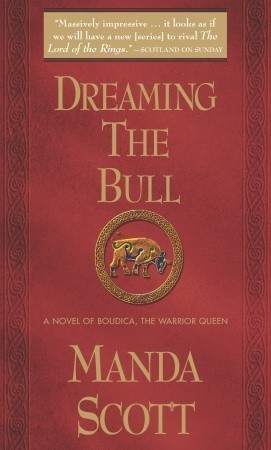
Book Review: BOUDICA: DREAMING THE BULL

As anticipated from my review of Boudica: Dreaming the Eagle by Manda Scott, I quickly picked up and pored through book two of this series.

I actually finished reading (listening to) Boudica: Dreaming the Bull at the end of May, but I’m just now getting around to posting my review.

Everything I loved about the first book – the writer’s elegant prose, the depth of historical world-building, the poignant interplay of the characters’ dialogue and gestures – carried through in book two.

While I missed spending as much time with Breaca as in the first novel, I was surprised and riveted by the stories of some of the other characters. The continued fall into darkness of Julius Velarius was not what I had looked forward to about this novel, but his chapters were compelling.

Scott did an excellent job showing how one can empathize with Julius, even when one disagrees with and even despises the choices he makes. His tragedy becomes the centerpiece for this book that still carries the reader through, without bogging them down in despair or anger. Those emotions are certainly felt, but they don’t hold back enjoyment of the wider story. Dubornos was another surprisingly interesting character in this novel.

This book was enjoyable overall. The consistency in writing style and attention to detail is a testament to Scott’s skill as a writer. As of this writing, I’m already 75% done with book three.

Steve D

Book Review: BOUDICA: DREAMING THE EAGLE and intricate narratives

Among my greatest literary addictions is historical fiction, especially that of pre-Norman Britain. Thus, it was only a matter of time before I came across, immediately bought, and read Boudica: Dreaming the Eagle, by Manda Scott.

This is the epic telling of Boudica, the Warrior Queen of the Celts who led the Celtic tribes of Britain against Rome’s second invasion in the first century BCE.

One of my favorite acknowledgments of this book is when Scott describes that very little – almost nothing, in fact – is actually known about who Boudica was, so most of the story of her life, her family, and the people whose lives she influenced are fictional.

Even still, this is a period in history that is so well-researched that the world comes to life from the very first chapter. Scott fully acknowledges the immensity of historical and archaeological resources and experts she leans on to construct this work. The payoff is a style of world-building and character-driven exposition that feels organic and does not overwhelm the reader yet completely envelops them.

The story generally follows the young Boudica – before she earns that title – and various members of her tribe as they prepare for the Roman legions to return to their shores. The characters’ connection to each other, through inter-tribal politics and vows of personal honor, drive the emotional weight of the story.

This book has brutal depictions of war, but Scott deftly works around the gory details to paint the tapestry of a battle from the perceptions of those involved. The reader can see the battle play out in their mind’s eye but does not need to be told about every stroke of a blade or every spurt of blood. The horrors of war are apparent without being gratuitous.

Scott’s narrative is incredibly detailed with not a single word or metaphor wasted. Her prose is elegant and precise, where dialogue between characters does not have to reveal every single thought in order to convey deep meaning.

This is flat out one of the best epic novels I’ve read. I’m already reading book two, Boudica: Dreaming the Bull.

Steve D