Book Review: THE LAST VIKING and the rhythm of narrative history

I am woefully behind on posting book reviews, which is perhaps a good thing. It means I’ve at least been keeping up with my reading. So here goes an attempted book review for a book I finished almost a month ago.

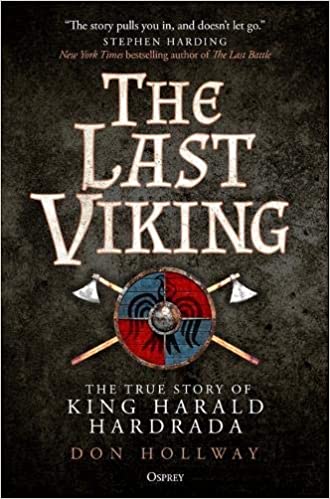
I listened to The Last Viking: The True Story of King Harald Hardrada by Don Hollway on audiobook, and it reminded me of the pleasing rhythm of well-constructed narrative history.

King Harald Hardrada was, as Hollway argues, the last great figure of the Viking age of Norse history. After his older brother, King Olaf of Norway, is killed in battle, the young Harald embarks on a wild life’s journey that takes him opposite corners of Europe, until his death in 1066.

Hollway uses a combination of historical sources and dramatized dialogue and exposition to weave together this history of Harald Hardrada’s life. His open discussion of his sources (or lack thereof, at times) and their veracity lends credibility to his understanding of Harald’s life. We have to take the information we have about a person who appears larger than life. Hollway then builds a narrative and life journey fit for a figure who appeared to be legendary in his own time.

To open the book, Hollway cleverly sets the scene for the battle of Stamford Bridge in England, 1066, where King Harald Hardrada of Norway met King Harold the Saxon, of Wessex.

Before the battle begins, Hollway winds the clock back to Harald’s youth. Following the death of his brother, the book follows Harald as he makes his way down the Volga and ultimately to Constantinople, becomes embroiled in the imperial court, and escapes as the reign of Constantine II collapses.

Harald then returns to his homeland and attempts to conquer parts of Sweden and Denmark from his seat in Norway, before finally embarking on his expedition to conquer England. This framing leads to a surprisingly climactic end for Harald, in which Hollway deservedly places him among the most influential figures of his time.

The Last Viking is an excellent read for anyone interested in the early medieval period of Northern Europe or the Byzantine period. For me personally, this book tugged at multiple threads in the history of side of my brain, and only reinforces my growing obsession with the early-Medieval period in Britain, and now Scandanavia.

Steve D

Book Review: NO GOOD MEN AMONG THE LIVING and the tragic debacle of the War in Afghanistan

Last month, I listened to the audiobook version of No Good Men Among the Living: America, the Taliban, and the War through Afghan Eyes, by journalist Anand Gopal.

I was barely a teenager when the War in Afghanistan began in 2001, and I remember the profound effect it had on me at the time.

When the war turned into an occupation and nation-building experiment, and then a resurgence of the Taliban, I knew that I didn’t understand the whole story. In the aftermath of the US’s abrupt exodus from Afghanistan, I was completely perplexed by how fruitless it had all been, with the Taliban back in power, and seemingly stronger than before.

Anand Gopal’s book traces the years before the American invasion, starting with the monarchy and Communist revolution in the 1970s, which prompted Russia’s occupation. From the late 80s and early 90s, Gopal begins following the involvement of various actors in the militias that formed in response to the Russian occupation, leading to the bloody civil war of the mid-1990s. The Taliban had gained control of large portions of the country by the outset of the American invasion, a sudden and confounding incursion, from the perspective of many of the locals interviewed, that was largely welcomed.

Gopal’s accounts of the lives of several Afghan people before and during the American war there is a fantastic narrative. It is also a devastating and infuriating demonstration of the downfall of American policy in the country.

The American policy, as told by several local actors and recounted by Gopal, had been to fight “terrorism” wherever it could be found. This led to local strongmen accusing their rivals of being enemies of the American mission, while American military leaders seemed completely clueless of the tribal rivalries and affiliations that had existed long before their invasion.

It is not difficult to see how the rise of strongmen across Afghanistan, funded by US taxpayers, created a self-perpetuating war machine that favored disunity and brutal politics, even as Afghanistan’s first democratic government tried to establish control.

Even though it was published in 2015, Gopal’s account also makes it easier to understand how the government could collapse so completely and utterly to the Taliban in 2021.

There were parts of this book that made me curse aloud at the sheer ignorance and brutality of it all. This book is not about choosing sides, except perhaps the sides of the civilians trying to survive the war. Gopal speaks to the cruelty of the first and subsequent Taliban regimes, but he also presents the reader with the callousness of American operations, many of which inadvertently targeted civilian homes or facilities (such as schools) that had no connections with the enemies the Americans were hunting.

This was not an easy read, but a necessary one for anyone who wants to understand what it might have been like to try to live through this war. It is tragic, infuriating, and shameful, and it makes me doubt what the American military and intelligence establishment has learned from this war, if anything.

I feel like the figures in this book have more stories that need to be heard, but I fear how they have fared in the intervening years.

Steve D

Saturday Of Book Reviewing – Albom’s tuesdays with Morrie

I’ve seen this book many a time on ‘inspirational and uplifting’ book lists, but had never considered that my wheelhouse, and thus had never before bothered to try to mine the wisdom from its pages. I can honestly say, post reading of Mitch Albom’s tribute to his former mentor and friend, that this was mildly inspirational, but heart-soaring-ly uplifting. You can tell I’m serious when I start making up words. So let us begin on this 1997 hit. It’s mini throwback time. Continue reading “Saturday Of Book Reviewing – Albom’s tuesdays with Morrie”