THE RINGS OF POWER reignites Middle Earth

Season one of The Lord of the Rings: The Rings of Power is in the books, and I, for one, am mostly pleased with how this season went. Here is my review of this show, where I will talk freely about everything that happened.

Spoilers ahoy!

Overall, I really enjoyed this show. The car was incredible, each of the storylines was fulfilling and had something to offer. Morfydd Clark’s portrayal of Galadriel is among my favorite performances in recent memory. Clark’s smoldering rage, steadfast determination, sword and riding skills, and empathetic story perfectly encapsulated such an iconic literary character.

The Harfoot plot was endearing and ultimately paid off with our very own Gandalf-like figure. In fascinated by the power this Istar may wield in future seasons.

The friendship between Elrond and Durin was heartfelt and funny. I just wish they hadn’t discovered the massive vein of mithril or woken the Balrog so quickly.

The Numenorean plot was intriguing, but I honestly expected a little more politicking there. Elendil feels like a strong character going forward.

Arondir, Bronwyn, Theo, and the Southlanders had some cool encounters with the Orks. I’m definitely looking forward to seeing more of Adar, who was somehow a sympathetic character despite wanting to block out the sun.

And Halbrand. I didn’t want him to be Sauron, but it became too obvious not to be true. His confrontation with Galadriel in the finale was legitimately unsettling.

My main gripe with this show is the pacing. I think they could have really benefited from at least two more episodes to draw out Halbrand’s trickery with Celebrimbor. My understanding is the production schedule was disrupted by the pandemic, so here’s hoping season two can be produced and released on time.

The Rings of Power was entertaining and recaptured the magic of Peter Jackson’s trilogy while adding new characters and new lore. I think this show’s biggest achievement is how much it feels like Tolkien, like Middle Earth. That’s a testament to all the details of dialog, set design, and story that the showrunners pieced together.

I’m already looking forward to a rewatch in preparation for season two.

How did you feel about The Rings of Power?

Steve D

Double Book Review: SWORD SONG and THE BURNING LAND and the narrator effect

After not achieving much on the reading front last month, I’ve powered through two consecutive books of The Saxon Stories series by Bernard Cornwell, upon which the Netflix series The Last Kingdom is based. I’ve slowly picked through this series over the last year or so after watching the Netflix show and hearing about the books from my in-laws.

I really enjoyed this series so far, but I’ve learned that my enjoyment of these books, more so than others I’ve listened to on Audible, really hinges on the narrator.

Sword Song, book 4 of The Saxon Stories

As the fourth book in the series, Sword Song may be my favorite yet. Uhtred has come into his lordship with household guards, an estate, servants, and a family, and he displays stern but fair leadership. Brash and arrogant as ever, he still does not hesitate to argue with or insult the other lords or clergy of Alfred’s court.

Sword Song winds through a closer character story where Uhtred is pulled between his oath to Alfred and his family, and a larger sense of duty to Wessex. This culminates in a battle for London, where the Saxons try to wrest control of the city from the Danes.

This book is also narrated by Jonathan Keeble, who is the best narrator for this series to this point. His various British accents feel authentic, he has an excellent tonal range, and his natural litheness with dialog brings a wit and charm to Uhtred’s character that really overpowers his cocky attitude and makes him likeable as a protagonist.

With the return of some old friends and a little more narrative room to breathe, Sword Song is a great catch-up that turns into a harrowing adventure. I enjoyed this book so much that I jumped immediately into the next installment in the series.

The Burning Land, book 5 of The Saxon Stories

The Burning Land is a less glory-filled story of Uhtred’s saga. Five books in, it’s not surprising that Uhtred’s fortunes start to take a turn for the worse, and that even his decision-making seems clouded by his own pride. This is a story of hubris, where Uhtred’s own comes back to bite him in harsh and tragic ways.

Uhtred tries to free himself of his oath to King Alfred of Wessex, and in doing so, finds himself int he company of the Danes of Northumbria. He dreams of retaking his ancestral home of Bebbanburg, but that dream makes him desperate, rather than savvy.

There are few exhilarating battles in this story. Rather, this story is weighed down by a more somber tone and drama-filled scenes as much of Uhtred’s character flaws catch up with him, even in ways he cannot control.

Unfortunately, this tone is made drab by the narration. Whereas Jonathan Keeble brought a humor and wit to Uhtred’s character and dialog, the narrator for The Burning Land was completely humorless. His narration style sounded more like a self-serious Shakespeare reading, which really dragged the story down for me.

I will definitely continue reading this series. However, this experience is making me wonder whether I really love these stories, or I just really love Keeble’s narration. I think the stories are good, but Keeble’s voicing brings an energy, an authenticity, and a weight to these books that I’m not sure I would find so readily on the page.

Steve D

Way-Too-Early Reactions to HOUSE OF THE DRAGON

It’s official. We’re back in Westeros after a 6-year hiatus from decent storytelling in George R.R. Martin’s fantasy universe.

As the first spin-off show we’re getting in the wake of Game of Thrones, I’ve been cautiously optimistic about this House of the Dragon.

With director Miguel Sapochnik, who directed several of Thrones‘s most harrowing and exciting episodes (see “Hardhome” and “Battle of the Bastards”), Martin himself more closely involved once again, and a star-studded cast, I felt like House of the Dragon had legitimate potential to be great.

After the debut episode, “Heirs of the Dragon”, all I can say is… I think I was right.

This premier introduced a set of characters who are poised to clash politically — or otherwise — and laid the groundwork for the rest of the season in an interesting way. They even managed to introduce a bit of lore that even the most ardent of book-readers could not have guessed.

I will not go into detail about the plot of the episode except to say that there is a jousting tournament with phenomenal cinematography and some pretty brutal violence. (The jousting show at the Maryland Renaissance Faire is one of my favorite events of the year, so I was thrilled to see such an exhilarating sequence in this show.)

I had honestly forgotten how unforgiving the early seasons of Game of Thrones could be, so to see it again in this premier was a bit of a shock.

While I have read part of The World of Ice and Fire, and Fire and Blood sits on my unread shelf, I’ve decided not to follow along with Martin’s writings while watching this show. I want to experience the show for its own merits, and then read the stories again.

Between the intriguing cast of characters, the tight-knit plot, the broader narrative it introduced, and the incredible looking dragons (more than one!), it’s apparent that the showrunners have set out to prove that the expanding Thrones-verse is still a force to be reckoned within the IP-as-content wars.

All in all, the showrunners have set the stage for what I anticipate will be an enjoyable, suspenseful, and action-packed season of television.

And of course, there are the dragons.

Share your thoughts or way-too-early reactions about this first episode of House of the Dragon in the comments below.

Steve D

Spare Parts for Broken Hearts – Songs that Stick to My Brain part 2

It’s time to return to my review of Spare Parts for Broken Hearts, the L.A.-based rock band whose eight singles have inhabited my ear space for the last couple of months.

When I listen to and review an album, the goal is to understand the music as a whole piece, rather than a critique.

I reviewed Spare Parts for Broken Hearts’ first for singles a few weeks ago. Today we’ll listen to the back four.

Previous post: Spare Parts for Broken Hearts – Songs that Stick to My Brain part 1

“You’re softer / When we collide

Gentle acoustic strums open “Pleasure Delay”, paired with lead singer Sarah Green’s off-kilter verses. The sound steadily builds with rhythm guitar and then drums.

Then the chorus hits with atmospheric sound–crashing cymbals, heavy chords, and eerie vocal tracks from Green behind the lyrics: “I could really show you something / I could be your one and only”

This song is a plea, perhaps for connection, but with a darker self-awareness, or maybe an admission: “But if you’re gonna die would you do it for me”.

“Take my hand and watch it burn”

“Say When” opens with a kind of slurring verse that seems to be directed at a former significant other. The music treads forward inexorably to a wailing chorus of old wounds: “Say when / Tell me you don’t want me then you hurt me just to stick around”.

In the second verse, the music quiets to a walking bass line and light drums, but Green’s vocals retain the anguish: “Take my hand and watch it burn / Oh I am shaking / From the love I can’t return”.

As in the first crop of songs from my previous post, “Say When” exemplifies Spare Parts for Broken Hearts’ ability to embody diverse and often conflicting emotional tones between songs, within songs, or even within a single verse.

“Build a bridge / Burn it down together”

“Mush” is the first song I ever heard by this group, and I was immediately struck by the weighty post-grunge overtones and Green’s ability to take her voice from warm and breezy to a full-throated gale and back in an instant.

I’m counting this entry as two songs, because the acoustic version of “Mush” is just as poignant as the full-band version. If someone had shown me the acoustic version first and told me it was the original, I would have believed them.

The authenticity of Spare Parts for Broken Hearts’ music is what resonates with me. It feels real, and even when the tones of the music seem to contradict the anguished lyrics, that contradiction feels intentional.

It makes listening to these songs a layered experience, even after the tenth or twentieth time.

Steve D

Spare Parts for Broken Hearts: Songs that Stick to my Brain part 1

See part 2 here.

I’ve spent the last several days listening ad nauseum to eight songs by Spare Parts for Broken Hearts, an LA-based rock band about whom I’ve been aware for at least a year, but had neglected to spend any significant time with. I’ve been missing out.

Last week I finally bought all eight singles that are available for download from their website. From what I can tell, they have yet to put out an EP or LP, but I’m still pleased with their eight-song playlist on my phone. (Reading the about page on their site, they plan to release an LP this year!)

Today, I’m going to take the first four songs from my playlist and look at them a little more closely. I’ll do the other four songs I have in a follow-up. I’m just doing these in the order they appear on my phone. If you’ve never read one of my album reviews before, I like to review the musical and lyrical tones of the songs and try to interpret them together. So this is not a critique so much as an attempt at understanding this music.

“I don’t want to be the voice of your prophet, your profit”

“Dirty Milk” opens with a fast, distorted bass line, feedback chords, and ringing cymbals. Lead Singer Sarah Green’s voice is melodic with just the right bit of scratchiness: “I am anonymous / Are you just like me / I need a friend”. And the refrain: “I don’t wanna be the voice of your prophet / I just want to be alone”

The song repeats its only verse and refrain twice each, never relenting until an abrupt ending that briefly fades out with squealing distortion feedback. This pace is more what you would expect from a heavy post-grunge band, but it’s not what Spare Parts for Broken Hearts typically do.

“Tell me the story from a different angle”

“Big Win” is more of a slow burn to start that builds into a soaring chorus: “All that I want from you / You can’t take back”

Even as Green’s voice rattles and nearly drowns out the dirty guitar chords, she still finds the space to lower her refrain to a gentle, almost sweet level, only to come back to a final chorus with fury and anguish. Spare Parts, or perhaps Green herself, perfectly blend these opposite emotional levels in most of their songs.

This is easily my favorite song of the bunch.

“I could swim til the bitter end”

“Cold Wave” similarly transitions from floating verse to torrential chorus and back. These transitions are jarring in that the listener feels the sudden weight of Green’s pain. Her first belting cry of “With no air” is powerful on its own, but its true meaning is only revealed when she growls: “I’m holding my breath / With no air”.

These songs run 3-4 minutes each– an average length– but each one is so full of sound and feeling that they feel like frozen moments.

“Where you end I begin / Severed”

Most of SPFBH’s songs are laden with inner turmoil, but perhaps none feels as forceful as “Ever”. Green’s wail on the first word of the chorus is a challenge and a rebuke: “What you can’t give / You can’t take from anyone.”

Plucking strings and distortion-rended chords. Soft hi-hat and crashing cymbals. Airy verses and wailing choruses.

All of these elements mingle throughout most songs for Spare Parts for Broken Hearts, and they never feel out of place or forced.

That the band can embody these dichotomies so completely is a testament to their songwriting skill and their authenticity. Whatever inspired these songs, I believe it, and that’s part of what makes them unforgettable.

I’ll come back with the other four songs in a couple weeks.

How do you like Spare Parts for Broken Hearts so far?

Steve D

10 Things I Loved about THE BATMAN

I had the pleasure of seeing The Batman with a friend on Sunday. Not only was it my first theater experience in over two years, it was one hell of a movie. I loved it.

Coming into this movie with no expectations, I didn’t know what to expect, in a lot of ways. I’ve been lukewarm on the DC universe’s approach to its movies, never quite knowing what their goal is for a given movie, so I didn’t pay much attention to the press tour leading up to this release.

Having seen the film now, I can safely and excitedly say that The Batman is a great movie from beginning to end, and Robert Pattinson is a great Batman.

I’m going to run down my favorite things about this movie, without spoilers. If you watch (or have already seen) the trailer below, nothing on my list will be a surprise to you.

My 10 Favorite Things about THE BATMAN

I’m going to say this is in no particular order, except the order that these are flying off my fingertips.

  1. Robert Pattinson’s brooding Batman and Bruce Wayne. Without speaking to the movie’s plot, I will say that I loved Pattinson’s portrayal of the Dark Knight in this film. He was brooding and tortured and honestly intimidating. I don’t know that any previous live-action Batman has felt as menacing to me as this character.
  2. Bruce Wayne’s relationship with Alfred. I had no idea Andy Serkis was playing Alfred in this film, and he was amazing.
  3. Jeffrey Wright as Jim Gordon. He was smart and subtly charismatic in the way you expect a younger Jim Gordon to be.
  4. The gritty Gotham. This was one of the more unique Gotham settings we’ve gotten in a Batman film, at least recently. The setting felt more like a comic book version of Gotham while still being believable. It seemed like it could still be a real city without feeling generic.
  5. The interplay of the various villain characters. This is a hallmark of Batman films, where multiple villains are bound to show up in big power plays. One thing that stuck out to me was the surprisingly personal moments that a few of the villains share with our titular character. These were not bland archetypal evil-doers with outlandish schemes. These were people with goals and motivations and fears, and that really helped to sell the plot.
  6. Cat Woman. Zoe Kravitz’s Selena Kyle was dynamic, could hold her own, and had incredible chemistry with Robert Pattinson’s Batman. I’m all in on those two.
  7. The Bat-mobile and car chase. You saw a piece of this in the trailer above, where the person Batman is chasing is shown in an over-the-shoulder POV. This is used to great effect during a car chase scene that is perhaps the most visceral car chase I’ve ever watched.
  8. The music. Again, the trailer shows some of the movie’s hand here, but there are two famous songs that are used and melded with a riveting hook to incredible effect that never gets old throughout the film.
  9. The details. This is the type of movie that has a lot going on to direct the viewer’s attention — lighting, silhouettes of characters, colors, and emotional facial close-ups. But there’s also a lot going on in the background. There are no extras looking awkward in any scene in this movie. Even in random corners of the frame, the actors are making it feel like a live scene, rather than a staged frame.
  10. The tone. I think the gritty, dark films can too easily fall victim to trying too hard to be edgy. It’s not trying to shock the audience with unnecessary gore or brutality, and it doesn’t drown the viewer in a cynical worldview. The grittiness envelopes the characters and drives a lot of the suspense and foreboding, but it’s beside the point. There is a lot more to this story than its gritty tones.
  11. One more for good measure! The mystery. This film is framed as a noir detective story, and Batman makes a convincing problem-solver. This style of storytelling helps to drive the plot and much of the suspense leading up to the final sequence, when the hero’s journey is ultimately revealed.

Well, those are my brief thoughts about THE BATMAN. I’m thinking I might need to see this in theaters again, because I can’t stop thinking about it.

Have you seen it? What did you think?!

Steve D

Review: PLAIN ENGLISH Podcast’s coverage of the war in Ukraine

I’ve never reviewed a podcast here before, but the more I find myself needing interesting and engaging information about in-depth topics, the more I turn to podcasts to get it. I simultaneously need to feel connected with what’s going on in the world without being inundated with opinion pieces, social media blather, and obnoxious punditry.

I was not following the major news outlets on Russia’s invasion of Ukraine. Instead, I had been getting bite-sized analysis notifications about once daily, but I needed more.

Plain English is a podcast on the Ringer where host Derek Thompson deep-dives into interesting topics. I had never listened to his podcast before, but after hearing about it from other Ringer shows (of which I listen to several) I noticed that he had done more than one episode on the ongoing war.

https://www.theringer.com/plain-english-with-derek-thompson-podcast

As it turns out, Thompson has done seven episodes on the war in Ukraine since its outbreak on Feb 25, speaking with military analysts, financial analysts, and even local Ukrainians about the war, its immediate impact, and its wider and longer-term implications.

I have listened to all seven episodes over the last four days, and I’m eager for more. Thompson takes a very complex subject that is destined to be shredded into a thousand opinions by a thousand talking heads on every network, and asks basic yet direct questions in his interviews with experts.

In the March 1 episode, for instance, Thompson speaks with two different financial analysts about the sanctions that the US and EU have slammed upon Russia, what they are really aimed to accomplish, and what the medium- to long-term impact could be.

What I particularly appreciate about Thompson’s concise narrative style is that he never loses sight of the very human tragedy that is unfolding in this conflict. Ukrainian citizens being targeted and killed in the action. And yes, Russian citizens’ outcries of protest being stamped out by their government, and the potential ruin that Russia’s economic crash could wreak upon people all over the world. (Listen to that March 1 episode).

This is not a case of “both sides”. Putin and the Russian government and military are obviously in the wrong, but their war, and the world’s sanctions against Russia will have real consequences for real people.

Thompson explains these points and much more without talking down to his audience, and with the goal of understanding above anything else. His discussions have made me feel like I can contextualize this conflict in more tangible terms without having to sift through the noise of an online news search or broadcast news clips.

Whether you are already well-informed on this conflict or not, I highly recommend this series of episodes on the Plain English podcast.

Слава Україні

Steve D

Midway Checkpoint: The Wheel of Time Show’s Jam-Packed Ambitions

Back in September, I allowed myself to get a little pre-hyped for Amazon Prime’s The Wheel of Time series, and I promised that I would check back in after the first couple episodes. The Wheel of Time show currently has six episodes released, and I have watched the first five, so I am definitely overdue for this post.

Spoiler warning: I will be discussing events in the TV show only, through episode 5–which maybe means this isn’t really spoiler-y. Anyway, anything that has happened in the first five episodes is fair game for this post. Although I am a current book reader I will not bring up any events from the books that have not yet been depicted on the show.

Honestly, I don’t feel like there’s a whole lot to spoil at this point in the series, which is maybe part of the problem I have with it so far. These first five episodes feel so packed with plot-building, and world-building, and characters, and movement that I have to imagine it’s difficult for casual viewers to keep track of everything and everyone that’s happened so far.

In five short episodes we’ve seen seven primary characters–Rand, Mat, Perrin, Egwene, Nynaeve, Moiraine, Lan–come together, split apart, and (almost) reunite in Tar Valon, while also meeting half a dozen other characters who appear to have some part to play this season. Stepin, Liandrin, Alanna, Logain, Eamon Valda, and Aram all seemed poised to round out a pretty full cast of characters and factions with whom that party-of-seven would have to contend. Stepin has already off’ed himself, and Aram seems to have exited the story for now, but this is still a list of characters I would…

a) never have expected to meet or be asked to care about in the first place,

b) never have expected to meet this quickly,

and c) don’t think quite fit together in an 8-episode season that is now more than halfway over with no clear central conflict having yet emerged.

The one through-line of all of this is that no one knows who the Dragon Reborn is yet, which, fine, that’s a mystery for people who haven’t read the books. But it doesn’t feel like a conflict to me.

I think my point here is that this show, so far, feels like an oversized plot that does not take the necessary steps to make me care about these people. I care, at the moment, because I’m reading the books, but that’s not enough when viewing this show in isolation.

Onto more positive notes…

Okay, I don’t want to be all cynical about this show, because I am enjoying it for what it is. The acting is great overall, the landscapes and set pieces are stellar, and the story has a compelling pace.

Listening to a podcast interview of showrunner Rafe Judkins has me confident that the man behind the curtain knows what he’s doing in trying to adapt a massive story to the small screen, where we do not have the luxury of 400 pages to tell the first part.

The first three episodes, which were dropped all at once on Prime, are heavy on lore and trying to get the viewer to even understand what the hell the Dragon Reborn is supposed to be. In hindsight, it makes perfect sense that Prime decided to present the first three episodes all at once. I think episode one on its own would have been too jarring for most people; it moves at a break-neck pace, introducing a host of characters and tons of lore, has a thrilling climax, and then ends with barely a moment to breathe.

Episode 4, in which Nynaeve discovers her ability to touch the One Power in stunning fashion, is when I decided I liked this show. I can see past the overloaded plot if we get moments as powerful as that a couple times per season.

Three more to go

Looking ahead, it’s hard to believe that this season is only going to be eight episodes. I really have no idea what sort of “ending” this first season could possibly have, unless they decide that season one is just a prologue.

All in all, I’m enjoying watching this show, but I have lingering concerns that the showrunners have tried to pack too much into so short a season for it to have much meaning. I hope to be proven wrong.

Steve D

Book Review: BRAIDING SWEETGRASS draws you in and inspires

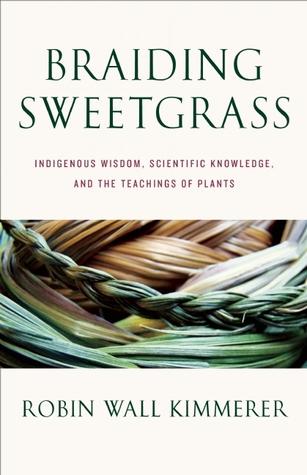
I recently listened to Braiding Sweetgrass: Indigenous Wisdom, Scientific Knowledge, and the Teachings of Plants by Robin Wall Kimmerer. This is another book I happened across while browsing Goodreads, and I gave it a shot to broaden my reading list a bit.

I can’t remember the last time I have been so completely inspired by a book — inspired to take action, but also emotionally.

Kimmerer’s book is a wonderfully woven selection of stories from her personal life, her career as an ecologist, and her own rediscovery of her Potawatomi heritage.

She cleverly leads the reader on a wandering journey as she tells of her own experiences as a student, a teacher, a mother, a scientist, an Indigenous woman, and a being with personhood (other beings with personhood include trees, plants, animals, rivers, basically everything in the natural world), to discuss the damage we have done and are doing to indigenous culture, to the natural world, and by extension, to each other.

I must admit that I found this book hard to follow during the early chapters. Kimmerer seemed to be telling random stories with no clear direction. But this series of vignettes begins to paint a larger picture as she describes a project she worked on with a fellow grad student to prove her hypothesis that sweetgrass would grow better with a human caregiver selectively harvesting it — a notion that goes against traditional Western science’s insistence that humans are separate from the environment, rather than an integral part of it.

In their experiment, Kimmerer, her colleague, and their team demarcate plots of sweetgrass and treat each one according to several variables. There were those they did not harvest at all, those they harvested by snipping at the stem, and those they harvested by pulling entire clumps of sweetgrass from the dirt. Over the course of two years, they consistently found that the plots where they were actively harvesting sweetgrass grew back better the next season. They did not wipe out an entire plot by harvesting, but instead let the sweetgrass regrow on its own terms. And they were right. This technique showed that the plots which were untouched did not regrow well at all — the older taller stalks of sweetgrass went untouched and prevented new growth, eventually choking out younger stems until their plots suffered.

There are almost too many lessons to try to take away from this book in one reading. From sustainable gardening and agriculture to on-the-ground conservation efforts to throwing support to indigenous communities’ efforts to reclaim their language and traditions, this book highlights a long list of efforts we need to make to provide a more sustainable future.

I came away from this reading both angered and inspired, frustrated and hopeful. Kimmerer does not offer hard and fast solutions — there are too many, and too complex, to enumerate in a single volume — but she does present the reader with a call-to-action, to begin pushing for change, or at least enacting change in our daily lives.

I like the idea of a larger, more sustainable garden that we can harvest vegetables from, and allowing sections of our yard to grow “wild” with shrubs and bushes native to our area and beneficial to the other fauna and flora. I also know that I need to identify local organizations focused on ecological restoration and sustainability, but finding these can be tough, at least at first.

It’s still difficult to pin down specific steps I can take as an individual towards a more sustainable future, but this book has laid the path. We just have to follow it.

Steve D

Book Review: KNIFE OF DREAMS sets up an epic final act for THE WHEEL OF TIME

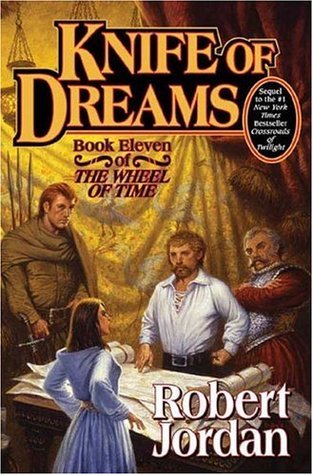
I recently finished reading Knife of Dreams, The Wheel of Time #11. You may remember that in my previous entries about some of the books in this series, I have lamented the plodding pace of the narrative, especially for particular point-of-view characters.

After a few books’ worth of dragging plotlines, Knife of Dreams finally brings some real momentum to this series, and ties off a few narrative threads in the process.

For the most part, the reader spends several chapters with a particular character at a time, watching their narrative unfold in more depth. Unlike in previous books, however, there is actually forward progress with the main characters, and Jordan even returns to each character towards the end of the book to see where they’ve landed.

I thoroughly enjoyed this book and was glad to find it spent the most time with only three of the primary characters: Mat, Perrin, and Elayne. There are check-in sections with Rand, Egwene, and others, mostly serving as compelling placeholders for things to come in the next book(s).

The three or four smaller plot lines that are all tied off in this momentous installment is clearly guiding the reader and each of the characters towards one thing: the Last Battle. With only three books left in the series — I say that as if each book wasn’t more than 600 pages — Knife of Dreams is definitely setting up the end game for the series.

I’m not ready to forgive the narrative slog that was books 7 through 10 (especially 10). I can see that groundwork that Jordan was laying for the mini-climaxes in previous books. I’m just not convinced that it needed to take as long as it did to get to this point.

Anyway, I feel like I’m over the hump of the middle part of this series, and I’m ready to jump into the final three books, which were completed by Brandon Sanderson after Robert Jordan’s death. The Gathering Storm (book 12) will be my first introduction to Sanderson’s writing, so I’m excited to see how he adapts Jordan’s story and narrative style. Then I can start reading Sanderson’s own work!

Steve D