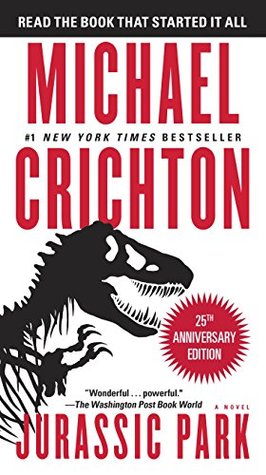
Book Review: JURASSIC PARK delivers thrills and layered plot-building

I just finished listening to Jurassic Park by Michael Crichton on Audible, a book I probably should have read years ago, but I’m glad I finally checked it off my list.

Jurassic Park the movie is one of my favorites ever, so I was excited to finally read the original novel that inspired it — and compare how the film adaptation differed from the novel.

I really enjoyed this book and basically couldn’t put it down for a few days. Overall, the characters each had unique voices, and the plot was compelling.

To my surprise and enjoyment, the first part of the novel builds up the background of Ingen, Hammond, and some other key players. There is a fair amount of techno jargon, but Crichton writes it in such a way that is accessible and, just as importantly, believable, at least as far as science fiction can be believed. These sections serve to enliven the story as it progresses, providing the reader with much-needed context to feel the weight of the story.

These early sections are then interspersed with vignettes of doctors or others encountering unidentified “lizards”, but none of the characters are able to piece together the clues. In this way the tension very slowly builds.

By the time the main characters arrive at Isla Nublar to tour the park, the reader is nearly overwhelmed with dread over the mystery “lizards” terrorizing the local population, the industrial espionage of a rival bioengineering company, and the shady, or perhaps negligent, designs of Hammond and the creators of Jurassic Park.

The story is incredibly layered with detail about all of the flaws with the park. There is no fatal flaw, but there are many tiny ones that create a perfect storm of a disaster, isolating the characters on this island in a nightmare scenario.

The action was thrilling but not overwhelming, and the plot kept pace as the situation continued to unravel. Ian Malcom’s continuous diatribes about chaos theory could be tiresome for some readers, but I found these more philosophical sections quite engaging.

The narration of the audiobook was great as well.

Regarding the film versus the novel, I find it quite remarkable how well the film adheres to the spirit of the novel, even if several key characters and plot points are either changed or omitted entirely. Those types of changes are to be expected when adapting such a detailed novel to film, but it only makes me enjoy the movie more knowing that it is a worthy reflection of Crichton’s story, even if it looks a little different.

Steve D

The Quintessential World-Building Tool

Creativity Sessions writing process. Evening Satellite Publishing.

If you know anything about me, you probably know that I like to use spreadsheets to organize myself, whether it’s story outlines, word count trackers (until recently), or timelines, the spreadsheet is my bread-and-butter organization tool.

So you’d better damn believe I have a spreadsheet laying out the entire millennia-spanning timeline of my fantasy universe, Úr’Dan.

Which brings me to the quintessential world-building tool, in my view: the Historical Timeline.

The Historical Timeline

When I talk about a historical timeline as a world-building tool, I’m not really referring to the timeline as a tool for the reader. It is a tool for you, the writer, to aid in your efforts to give depth to your fantasy universe.

Even if you only have a few key events laid out that underpin your fantasy universe — a recent war, a plague that is sweeping the countryside, or the death of a prominent figure — it is essential that you understand not just how and why these events happened, but when.

And a simple timeline, or an outline of a timeline, can help you organize key events to tell your story accurately. After all, referencing historical events in the course of your story through dialogue or, where appropriate, exposition adds greater depth to your fantasy universe, but only if you can consistently describe when and how something happened.

My Historical Timeline

As I said at the top, I use a spreadsheet to organize a millennia-spanning historical timeline for my entire fantasy universe, called Úr’Dan. This spreadsheet is organized into four columns:

  • Year, or whatever reckoning of time is used in your fantasy universe. There are actually four distinct calendars used in Úr’Dan, so my timeline references each.
  • Name of the event. How is this event known in your story? Consider whether different groups refer to the same event by different names.
  • Peoples involved, referring to which larger ethno-cultural groups in my story were involved in or impacted by a particular event.
  • Description, providing just a few sentences summarizing what the event was, and maybe what it’s immediate impact was.

Additionally, I use color-coding to provide a quick visual differentiator between general types of events:

  • Events referred to only in myth or legend
  • Wars, battles, or other conflicts
  • Founding or construction of cities, fortifications, or other significant places
  • Birth/Death of prominent figures
  • Treaties or alliances
  • Other significant events, trends, discoveries. This is a catch-all category that can include things like mass migrations of people, the invention or prevalent use of a particular type of technology, or notable weather events.

Finally, I also include rows for each of my stories, just so it’s obvious where they each fit into my timeline.

All told, I have 91 rows in my timeline so far, spanning about 1,000 years of “history”, plus significant events of myth, such as those covered in my mythology of Úr’Dan. Many of these events are focused on a few ethno-cultural groups or time periods that I’ve already put a lot of thought into, so one of my ongoing goals is to add more events and flesh out the histories of all of the peoples of my fantasy universe.

The more historical events you can talk about from your timeline, the more space you have for potential stories.

Steve D

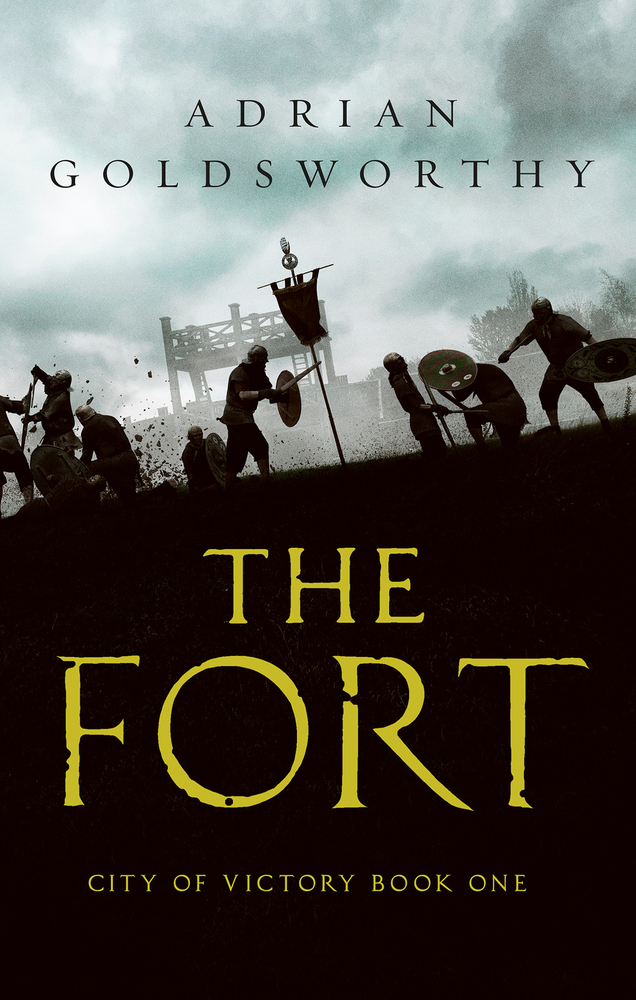
Book Review: THE FORT, continues Goldsworthy’s run of compelling Roman military fiction

The Fort, City of Victory Book One is the first in what I assume is a new series of Roman military fiction novels by Adrian Goldsworthy, author of The Vindolanda Saga. I had read and thoroughly enjoyed that trilogy last year, so I jumped at the chance to read Goldsworthy’s newest work, only released in June.

I further hoped that this series would continue the saga of Flavius Ferox, the Roman Centurion and Prince of the Silures of Britannia whose dual-lives are always in conflict as he serves Rome.

The Fort once again follows Ferox, who has just arrived to a new posting in Dacia, a Roman province long troubled by local tribes and in which the Emperor Trajan had only recently established a more permanent foothold.

This continuation of the saga of Flavius Ferox is well written and narrated. The plot beats will feel very familiar to readers of Vindolanda, but I did not find the story as compelling as Goldsworthy’s earlier series. Ferox arrives in his new post in command of a detachment of Brigantes, all sworn to their new Queen Claudia Anica (herself sworn to Rome and now Ferox’s wife), and expecting a battle against the Dacians. The battle comes, of course, and becomes a siege of the fort whose name I can neither spell nor find online. (It’s possible this was fabricated for Goldsworthy’s story, like the titular fortification of Vindolanda of the previous series.)

Aside from mainstays like Vindex, Claudia Anica, and Sulpichia Lepidina, there is a largely new cast of characters. I found the politicking of Roman bureaucrats a bit dull in this story and even difficult to follow. It seemed like several characters were introduced and then discarded before the end of the story, except for Hadrian, tribune sent to Dacia, nephew of Trajan, and (for anyone who knows a bit of Roman history) the future emperor. Without giving away the ending to The Fort, Hadrian’s relationship with Ferox is likely drive much of the personal and political conflict in upcoming stories, and that is something to look forward to.

Other than that, I found myself leaning pretty heavily on Ferox’s interactions with his three close friends to stay attached to this story. I think the best scenes were those between Ferox and Claudia Anica, who lightened the tone of the story while carrying great narrative weight as a character.

The scenes which followed Brassus, a leader among the Dacians, were interesting but only scratched the surface of that people. I don’t feel I really know anything about the Dacians except that they obsess over “ascending” and “purity”, supposedly sacred concepts that are tossed around with no real explanation.

Overall, I enjoyed the story but pretty much knew what to expect from Goldsworthy’s writing and narrative.

The narration in the audiobook version (on Audible) was good, although the pronunciations have all changed. The narrator used softer s sounds in place of the Roman c, which I’m not here to quibble about. It’s just an interesting choice after the strictly Latin pronunciations in the Vindolanda stories.

Steve D

Haiku Sunday – Brothers

“Brothers”

Cut from the same cloth,

fragments of the same pattern,

yet unique, themselves.

Steve D

Our son was born on Wednesday! We did not know we were having a boy, keeping the surprise for ourselves again. It’s wild to think that our older son, now almost 3, is now an older brother. Can’t wait to watch these two grow up together.

August Write Day: Turning the Corner

July was a solid month, writing and otherwise. I had a lofty goal, but I also had a plan to meet it. That plan went… alright. There were some bumps in the writing road, but I met my goal for the second month in a row!

And I made some crucial progress on my story, both in the actual writing and in figuring out where it’s headed as I plunge into the third act.

Let’s get to the goals already!

Last Month’s Goals

  1. Write 10,000 words.
  2. Read 3 books.
  3. Enjoy parental leave.

Write 10,000 words?!

YES! I wrote 10,054 words in July, in fact. How did I do it, you ask?! With a pretty hefty push in the final week of the month.

The middle two weeks or so did not go well for me, writing-wise. I fell behind and struggled to keep up, and then to catch up. Our toddler hit a new phase in July where he’d get home from daycare with my wife and pretty quickly throw an ear-shattering tantrum over basically nothing. It’s clear that these tantrums were (and are) because he’s hungry, but somehow the toddler will not listen to reason and sit down to eat a single bite of food. Weird, right? Who knew that toddlers were completely irrational gremlins.

So, I’d hear the tantrum start as I was finishing up work upstairs, and instead of staying upstairs to write as has become my routine, I more often went down to morally support my wife and emotionally support our meltdown-having son. That’s honestly the reason I didn’t get much writing done for the middle part of the month.

HOWEVER…

I still hit my goal.

There’s my progress chart from NaNoWriMo. You can see I started to fall behind almost immediately, but the wheels really came off around the 12th. I just could not sit down to write each day, and even when I could, it was for a pittance of words at a time.

But, I decided to knuckle down at the end of the month and try to close out strong. Over the final five days I wrote 6,000 words. That final spike on July 31 took three writing sessions, one around 12-1am, one around midday, and one that evening.

The other great piece of this is that, even with all the writing struggles, I still wrote 17 of 31 days. That persistence throughout the month was key to me striving for that goal at the end.

Read 3 books?

Nope. I think I technically finished Return of the King on July 1, but my reading was pretty lacking. Part of that was due to my focus on writing, but I also didn’t have any books pulling me in. I had started reading a work about the importance of nature in children’s lives, a fascinating read, but not the type to really call out to me. I’ll finish that in due time.

I started listening to The Fort, the first in another series by Adrian Goldsworthy, the same author who wrote The Windolanda Saga, following the same main character. I’m nearly finished that on Audible, but that’s about it.

Enjoy paternity leave?

No, because the stubborn kid hasn’t come yet! My wife is nearing 42 weeks, and our midwife already told that if we got to this point, our options were either to induce labor or have a c-section. We’re headed to the hospital Wednesday morning (I’m writing this Tuesday night) for the planned delivery.

Unlike our first, who literally kicked his way out of the womb almost a month early, this one has no interest in facing this capitalist dystopian hell-scape wonderful world. So my paternity leave starts next week!

Goals for August

  1. Actually enjoy paternity leave. My three-week leave officially starts next Monday, and I’m really looking forward to getting to focus on time at home with the family. The toddler will stay in daycare so as not to disrupt his schedule, but I’m excited to see him interact with his new sibling.
  2. Write 8,000 words. I feel really good about this one, considering I wrote 10k in July even with some hiccups. I have no idea how this will go with an infant and, oh yeah, the toddler, but I’ve gotten a head start.
  3. Read 3 books. I don’t like how little I read in July, but that’s the trade-off sometimes. Hopefully I’ll be able to find the time during my leave.

Steve D