“Know”
Watch expressions shift.
What thoughts flicker behind eyes.
Discovering you.
Steve D

Watch expressions shift.
What thoughts flicker behind eyes.
Discovering you.
Steve D
Footprint sticks in mud
resisting every next step,
stamping down in spite.
Steve D
A hundred marbles
clatter to the floor to clack
in all directions.
Steve D
Now that we’re nearly five months through the year, and with my writing progress not going as quickly as I had hoped to this point, I’d like to take a look at the particulars of my writing habits this year. This is on my mind, because I’d like to start doing conventions again in 2022, and I would like to have some new material to showcase.
My ongoing work-in-progress has been a two-part novella that I will publish as separate stories in ebook and then print as one volume for conventions: Uprooted, The Herb Witch Tales #1 and [untitled], The Herb Witch Tales #2. I haven’t technically finished the first draft of part 2, and I am really only just starting a third revision of part 1, followed by a pretty significant overhaul of part 2.
In short: I’m not nearly as far along in this process as I had hoped to be, considering I would like to have these stories published and ready for readers in the next 12 months, if not less.
So, I’m going to examine my own writing progress so far this year and try to identify where I can improve — aside from just Writing More.
First let’s look at the overall progress I’ve made month to month compared to my goals for those months:
Okay, that’s not bad. I came up short, but still made really solid progress.
The last three months were markedly worse, although after a significant drop-off in writing productivity in February, I’ve started to climb back up.
Still, that’s a deficit of 7,728 words written in the first four months of this year. Let’s break this down further.

That image is from my NaNoWriMo writing goals tracker, which I’ve been using all year to track my daily writing progress and my monthly goals. The light blue line is a daily average to achieve my writing goal for the month; the dark blue line is my actual writing progress. Looking at my January progress above, a few things become immediately apparent:
There are some obvious conclusions to draw there, but let’s look at the other months first.
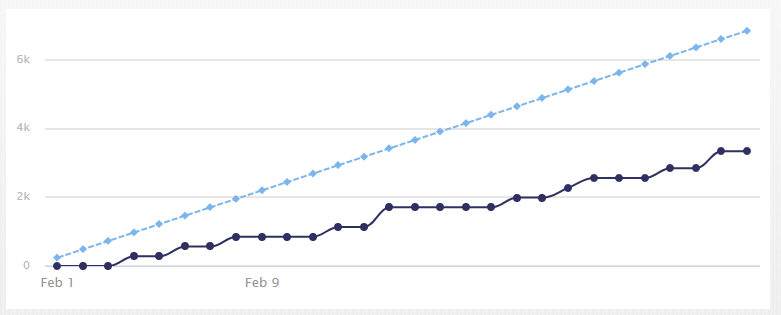
There’s February. My progress was a little steadier, but I still only logged progress 10 days out of 28. There are also two noticeable gaps where I went a few days without any progress. My pace looks steadier in that line graph than in January, but I just didn’t write enough.
And it’s much the same story for March and April, respectively. I don’t want to overload this post with screenshots of line graphs, so I’ll just summarize those months:
So out of 120 possible writing days from January through April, I only logged writing progress on 32 days. That’s time spent writing only 26% of available days. If I extrapolated that across the year, I would only write about 95 days in 2021.
I’m never going to be an everyday writer, and I haven’t tried to be in a long time, but I feel like that effort is pitifully low.
For the 32 days I actually sat down to write, my average word count per session is 566, which is honestly higher than I expected. If I can have that same kind of output over the course of more days, my writing progress could take a noticeable leap.
I’ve also had a habit of getting a late start in in the month, going several days or even a week before logging my first writing progress. This leaves me far behind my goal and scrambling to catch up.
Finally, I too often have gaps of 3+ days between writing sessions. That is obviously part of what contributes to me only writing somewhere around 10 days out of each month. I just need to write more consistently.
As I said at the top, I need to be a bit more proactive than just trying to Write More. I need a better strategy to fit writing into my day, even if it’s not every single day.
I started to try one new strategy at the end of April, and it really seemed to help. I think it’s also helping me write mote often in May.
I started to bake writing time into the end of my work day. I’m still working from home for at least the next couple months, so I started to logoff my work computer around the usual time, and then login to my personal/writing computer for 15 minutes or even up to an hour to focus on writing.
This allows me to use the mental energy that I typically still have at the end of my work day to focus on my writing. Otherwise, I logoff work, spend time with the family, prepare/clean up after dinner, try to relax a bit, and by that point it’s 9 or 10, and I’m exhausted.
Writing immediately after work allows me to decompress, tends to be more fruitful than writing later in the night when I’m tired, and allows me to relax with my family more without the weight of not-writing hanging over me.
I’ve written 7 out of 18 days in May so far, and my word count per session is around 400. With two busy weekends in a row coming up, I need these post-work writing sessions to carry me for the rest of the month. We’ll see how it goes, but this is already working better for me than my previous non-strategy.
Steve D
Mingling in a group
feels like a luxury we’ve
all but left behind.
Steve D

Exit West has been in my Audible library for at least over a year — when Audible used to make their Originals content available as part of a monthly selection.
I picked it up and sort of forgot about it, buried at the bottom of my Not Started list. I finally decided to give it a shot.
I ended up enjoying Exit West much more than I had anticipated when I first started. Mohsin Hamid’s narrative starts off slowly, the first couple chapters introducing the protagonists, Saeed and Nadia, in terms of their relationships, families, and how they were raised in a predominantly conservative Muslim society.
What’s interesting is that Hamid never names the country in which Saeed and Nadia live, and the particulars of the political conflict that upends their lives is inconsequential. Hamid chooses to focus on how it impacts them to tell a story that could apply to any two people, from any society, at any time in human history.
This is reinforced in the structure of the story. Hamid uses a methodical narrative style to capture vignettes of the lives of his characters. He then extends this to nameless characters we meet only once, snapshots of people’s lives who on the surface have no relation to the protagonists but whose shared experiences enliven the story.
Hamid presents a fictional future that likely already exists in some countries and will be more widespread over the coming decades. As the political conflict quickly turns to civil war around them, Saeed and Nadia are forced to hide out in their own homes before making the heart-wrenching decision to escape through one of the many doors that transports people from one life to another.
This is a world in which human societies are more divided but also more interconnected, where large groups of migrants have to eke out their existence in new places, fundamentally reshaping the identity of the places they come to inhabit, as well as themselves.
Saeed and Nadia try to hold their fraying relationship together among this emotional tumult, and their bond becomes the strongest force holding the narrative itself together.
Speaking of the audiobook version, Hamid’s narration is steady, and emotional notes come not in his inflection, but in the meaning and rhythm of his words.
I’m pleased to find two other stories by Hamid available on Audible, and regret not listening to him sooner.
Steve D
Change and change again
like the course of a river,
ever persistent.
Steve D
April went by pretty quickly, but there has been movement in various streams of my life. I’ve gotten both doses of my COVID-19 vaccine, and we’ve started making real preparations for the new baby. I don’t think I’ve mentioned that yet. Baby #2 is due in late July, and we now have two cribs in one room. Sure hope the toddler doesn’t mind sharing!
I’m also quickly getting into my summer groove of not wearing socks and actively trying to get out of my house more. This will be an exciting summer.
Anyway, onto the goals.
I wrote 4,500 words in April, which is better than in March, but still not good enough. Towards the end of the month I started taking 20-30 minutes after I logged out of work to write a few hundred words, the idea being that I could probably be more productive by writing while my brain is still in work mode. It largely worked. This strategy helped me write about 2,000 words in the last week of April, but I started doing it too late in the month to catch up.
The first chapter of The Herb Witch Tales #1 is already several hundred words longer than in my previous draft. I’m also brainstorming a pretty big change to the middle of the story, diverting the characters from a particular locale and plot thread that was problematic to begin with. It could help me streamline the narrative a bit, but it also means writing more from scratch than I had originally planned on for part 1.
In any case, I want to accelerate my writing. The goal is to have these two stories complete by the time I go to my next convention. That may still be 12 months away (at least), but that’s not a whole lot of time in the publishing realm.
Yes! I finished The Fellowship of the Ring, read a comic volume, and listened to Super Black on Audible, which I recommend to anyone interested in comics, history, or American culture.
I’m a quarter of the way through The Two Towers and nearly finished with another Audible short fiction. I’m already eyeing my next audiobook, but May is looking like a strong month for reading.
I think so. We had a couple weekends hanging with family, which is always nice. The toddler has a push bicycle — one without training wheels or pedals that he just pushes with his feet — but he discovered wheelbarrow rides at his grandparents’ house last weekend. Guess which one he preferred?
The last couple weeks have been more relaxing, mostly because I completed a big work project that was taking up a ton of my headspace. But like I said at the top, I’m quickly settling into summer, which means a lot of lounging, walking, or wandering outside.
Steve D
Bump along the grass
in a rusty wheelbarrow,
small rollercoaster.
Steve D

I picked up Super Black: American Pop CUlture and Black Superheroes by Adilifu Nama on Audible recently, and really enjoyed the information and lessons Nama presented.
Nama’s central theme is that black superheroes are more than tokenism brought to the comics page, which is how they are often talked about or analyzed. Instead, Nama explores how black superheroes have engaged in or even shaped the narrative of race and racial identity in American culture.
I was immediately impressed with Nama’s academic approach to this effort. He spends the first chapter laying out his thesis, his methodology, and refuting the arguments of previous analyses. He also is shy in criticisms of specific comics or stories for their over-reliance on stereotypes and insincere storytelling. It is not difficult to tell that he is a fan of comics, and he even mentions the effect that comics had on him as a boy, but he also wants to provide a considered analysis, and he does.
Nama looks at each of the most prominent black superheroes, as well as a few who made a particular mark on the discussion of racial issues.
He takes this a step further by examining other genres of media to discuss how black superheroes, at their best, have presented an encouraging image of Afro-Futurism, and often led the way in bringing those themes to the sci-fi and fantasy genres.
Even for someone without a deep knowledge of comics lore or history, this book is an engaging review of the most prominent Black superheroes and their depictions over the decades. Analyses of Black Panther, John Stewart’s Green Lantern, Power Man / Luke Cage, Black Lightning, Brother Voodoo, the Falcon, and Storm jumped out to me. Nama also discusses a run of Hal Jordan’s Green Lantern and the Green Arrow, which managed to touch on social justice issues in America in the 70s, not long before John Stewart debuted as the Green Lantern.
Nama then spends some time examining the superhero status that Barack Obama attained in the American psyche in the run-up to his election in 2008.
I really enjoyed this book and will definitely be looking for some of the comic arcs that Nama discusses to better understand these stories.
Super Black was originally published in 2011, when the Marvel Cinematic Universe was just getting started — really before “MCU” became a widely understood pop culture term. I am curious how Nama would examine the growing on-screen prevalence of black superheroes since then.
Black Panther became one of the MCU’s most iconic characters almost overnight when that movie debuted in 2018. Before that, both Don Cheadle and Anthony Mackie had supporting character roles in various films, as War Machine and the Falcon, respectively.
And now Marvel presents us with The Falcon and the Winter Soldier, a limited series that earnestly shines a light on racial injustice in America and wrestles with the notion of a man being both black and Captain America in 21st-century America.
I think it’s easy to be cynical about a huge corporation owned by an even huger corporation trying to convince viewers that they care about social justice, but the fact is that Black Panther (and it’s upcoming sequel) and The Falcon and the Winter Soldier are stories about black superheroes with strong themes of Afro-Futurism (especially in Black Panther) told by black directors and writers. That’s not nothing, at least in my view.
I’d still like to hear what Nama thinks about those stories of significant black superhero figures though.
Steve D
 Evening Satellite Publishing