The Bright Sword by Lev Grossman is a deeply intimate retelling of the Arthurian legend, of the rise and fall of dynasties, and of the meaning and power one person can hold over kingdoms, countries, and his dearest friends and relatives.
I picked up this book on Audible without any prior knowledge of it, and I greatly enjoyed it.
Grossman pulls all of the legends of the Arthurian tales – Bedivere, Gawain, Gallahad, Lancelot, Morgan, Morgase, Guinevere, and many others – and brings them into a grounded story of the final days of Arthur’s reign.
Without giving away any spoilers, Grossman does a great job of blending the main plot with flashback chapters to explain how each of the main characters got to where they are in the story. This structure served to drive the narrative forward while helping contextualize and humanize the larger-than-life figures one expects to meet in a tale of Arthur.
The story’s use of both fae and Christian mythology was fascinating and only added to the world-building. This is a true high fantasy tale, and the author (as he admits in his note) takes some liberties with historical accuracy.
This is all fairly smooth in the actual reading; the overarching plot and abundant appearance of magic mean there are no illusions about this attempting to be historical fiction.
Would definitely read again, as well as Grossman’s other novels.
Manda Scott’s fourth novel in the Boudica series, Dreaming the Serpent Spear, was a fantastic ending to an epic saga about Boudica’s rise and rebellion against the Roman Empire in Britannia.
Where book one primarily covered how Breaca, daughter of the royal bloodline of the Eceni, rose to become a warrior and leader of her people, books two and three dove into the characters’ their internal struggles and the manifestations of their various choices on and off the battlefield, casting some of them far afield, with no apparent hope of ever reuniting.
Dreaming the Serpent Spear managed to bring many of the main characters’ arcs colliding back in a final clash to decide their individual fates, and that of the Celtic and druidic peoples of Britainnia.
Author Manda Scott treated the lingering trauma of Breaca and Graine with care while demonstrating their growth as individuals and in their relationship as mother and daughter. Other characters, like Cunomar, Sigve, Valerius, and Corvus also stretched and grew into their own – at times surprising – fitting ends.
The sense of dread throughout this read forced me to a slower pace. Knowing that Rome occupied Britannia for another century-plus after the timeframe of this novel meant that I did not expect a happy ending. I didn’t want to see beloved characters die in battle or languish in imprisonment.
However, I think Scott deftly navigated the brutality and desperation of the final battle and brought the characters’ stories to worthy resolution.
This series is absolutely worth a re-read and will sit among my favorite novels on this historical period.
In my October Write Day post, I started to ponder what my medium-term writing goals really were. I’ve been diligent about setting monthly goals for myself, just to ensure I’m focusing some of my energy on my hobbies, like writing.
I also know what my super-long-term goal is: I’d like to have multiple published stories that I can take to conventions and book festivals. I want to actually meet people who may be interested in reading my stories, not just try to sell online.
My current work-in-progress, which I’ve generally referred to as “The Herb Witch Tales”, is a duology of novellas that I intend to publish as one volume in print, to keep printing costs down. My next intended project is the sequel to Warden of Everfeld: Memento, which will be a full-length novel. While I have a solid start on that novel I had started drafting in 2018, it will not be ready for publication quickly.
At the moment, I have one published book and a slew of online short stories that are not ready for print form. I definitely need more than one book in order to make paying for tables at conventions worth the cost.
But I’m also concerned about pushing to publish my current work-in-progress, doing a bunch of marketing, going to some conventions, and then not being able to publish anything for a few more years.
That doesn’t seem like an effective way to sell books. I also don’t want “final” drafts to languish on a hard drive somewhere without seeing the light of day.
So maybe that’s the answer. I’ll publish my current work-in-progress when it’s ready, not make a huge deal about it, and continue with my next project. Once I have three books to sell, then I can start to consider my proactive marketing and conventions.
It just may take a few more years to get there.
Do any other writers out there stuggle with this question? Do you feel pressure to publish every year?
Creativity is tricky. Trying to be creative is even trickier.
In recent months, I’ve found myself searching for more of an outlet for my creativity. Writing stories is my first creative love, but the fact is that it comes with several limitations, some of which I may be unnecessarily imposing on myself.
I also struggle with a lot of the mental aspects of sharing my creativity with others, especially through social media. How much sharing is too much, too revealing, too damaging to my own privacy? Ideas run through my head all the time, and I feel compelled to share them with people, but I often don’t, or perhaps more often I share them in person with my wife or my friends. That type of creativity sharing can be quite cathartic, but it leaves open the question of whether, and what, and how I share my creativity beyond that limited group of people.
This very post comes out of a sense of frustration that I didn’t have something else to write about. So, I’m going to do some unpacking here and see where it takes us.
Limits on My Creativity
I mentioned above that it feels like there are limits to my creative outlet in writing stories. As soon as I wrote that, I thought that many of those limits must be self-imposed, so I’d like to examine them. In no particular order:
Not enough time
Worries over my copyright
Keeping ideas about my fantasy world-building close to the vest
Limited formats
Limited platform(s)
Five off the top of my head; not bad. That should be enough to delve into for a bit.
Not enough time
I’m not a full-time writer and likely will not be in the foreseeable future, so this limitation is partially by circumstance. However, I think it’s also due in part to the way in which I approach writing. I primarily write novels or at least short stories, and so sitting down to write 100 words doesn’t feel like much of an accomplishment.
Now, look, I fully realize that every little bit counts towards the greater goal. I get all the writing mantras. But it can be difficult to maintain that steadfastness day-to-day, week-to-week, month-to-month as you churn over a longer story.
Worries over copyright / protecting my ideas
I’m combining items two and three, because they feel very much related, although still different
Worries over copyright infringement is not easy to navigate, especially online, as I discussed last week. But even beyond the notion of someone stealing my work, I’m quite protective of my creative ideas, especially when it comes to my world-building universe.
With enough prompting, I can quite easily ramble about the myriad ideas I have for my fantasy universe, but I sometimes worry that speaking my ideas out loud will… release them from my mind. As if the words roll off my tongue and the ideas themselves evaporate.
Strange, I know. I’ve learned to be careful about how much I reveal about my stories, my ideas, and where I might take them, because I don’t want to lose the drive to write them down. Speaking them out loud is a form of sharing them with the world, but I know I can develop them in so much more depth and with more coherence if I write them down. So, I try to “save” my ideas for my writing, or maybe only discuss certain aspects of them, if I want to workshop them with someone I trust.
Another piece of “protecting” my ideas springs to mind.
Limited formats / platforms
I’m also combining items four and five.
I realize that there are tons of platforms out there where I can publish stories for various online communities to read. Wattpad, Tumblr, Reddit, IngramSpark, Kindle, this blog… and literally hundreds or thousands of other websites I cannot even name.
But does publishing my story in one space restrict me from another? Is a freemium story platform like Wattpad too open to exploitation of my ideas? Is there just too much damn content online for any of this to matter? I have no clue.
Creative Limits
If you couldn’t tell, I’m in the process of reassessing how I write and publish my stories. I love the idea of publishing novels, and I will continue to strive for that. But if I’m only publishing a novel once in a blue moon, then where do the rest of my ideas go? Is there somewhere else I can put them to get them into the world without feeling exposed — to copyright infringement, or loss of my ideas to the ether, or whatever else?
These questions bug me, so to this point I’ve resigned myself to the full self-publishing process with novels, novellas, or short stories, because it feels more official, and safer.
But I think I can find something else to fill the drawn-out in-between spaces — spaces in my head, in my publishing schedule, in my day-to-day schedule where smaller ideas can be nurtured and thrive. I just don’t know what yet.
Exit West has been in my Audible library for at least over a year — when Audible used to make their Originals content available as part of a monthly selection.
I picked it up and sort of forgot about it, buried at the bottom of my Not Started list. I finally decided to give it a shot.
I ended up enjoying Exit West much more than I had anticipated when I first started. Mohsin Hamid’s narrative starts off slowly, the first couple chapters introducing the protagonists, Saeed and Nadia, in terms of their relationships, families, and how they were raised in a predominantly conservative Muslim society.
What’s interesting is that Hamid never names the country in which Saeed and Nadia live, and the particulars of the political conflict that upends their lives is inconsequential. Hamid chooses to focus on how it impacts them to tell a story that could apply to any two people, from any society, at any time in human history.
This is reinforced in the structure of the story. Hamid uses a methodical narrative style to capture vignettes of the lives of his characters. He then extends this to nameless characters we meet only once, snapshots of people’s lives who on the surface have no relation to the protagonists but whose shared experiences enliven the story.
Hamid presents a fictional future that likely already exists in some countries and will be more widespread over the coming decades. As the political conflict quickly turns to civil war around them, Saeed and Nadia are forced to hide out in their own homes before making the heart-wrenching decision to escape through one of the many doors that transports people from one life to another.
This is a world in which human societies are more divided but also more interconnected, where large groups of migrants have to eke out their existence in new places, fundamentally reshaping the identity of the places they come to inhabit, as well as themselves.
Saeed and Nadia try to hold their fraying relationship together among this emotional tumult, and their bond becomes the strongest force holding the narrative itself together.
Speaking of the audiobook version, Hamid’s narration is steady, and emotional notes come not in his inflection, but in the meaning and rhythm of his words.
I’m pleased to find two other stories by Hamid available on Audible, and regret not listening to him sooner.
After some lackluster reading the last month or so, I am embarking on an epic quest: to reread The Lord of the Rings!I will not be reviewing these stories in a critical sense, because how could I? Instead, I will share some storytelling insights I pick up as I go along.
This will be primarily focused on the books, but I will also reference the films by Peter Jackson to compare the stories as they are told between these two media.
I just finished reading Crossroads of Twilight, the tenth book in Robert Jordan’s The Wheel of Time series. I’ve already mentioned this book a couple times in recent posts, mostly because it took me longer than I expected to get through it. And not in a good way.
Ten books into this series, I’ve run into more than a couple of stretches where there doesn’t seem to be any real narrative movement, and the characters’ insistence on running in place when there’s a path laid out for them has been frustrating.
This book, however, was the hardest installment of this series for me to get through. Rather than running in place, or even building up to something, the characters in this book just did nothing.
There were a lot of conversations, a lot of plans being made without any details as to what they were, or even what they were aiming to achieve, and a lot of schemes.
Always with the schemes in these books.
Schemes within schemes that are so convoluted, so tepidly hinted at by the POV character of the moment, that the reader can’t possibly have any real clue of what’s really happening. There are so many characters now in this series, and they all have their perfect little plans laid out and ready to spring, except the reader has no idea what any of them are, and there are 200 of them!
Ugh.
So, yeah, this book took me some time to get through. I was simply not interested in most of what was happening. I read the last third of this book in fits and starts just trying to get to the end.
The structure of the chapters was at first intriguing to me. The book is structured in such a way that you follow one particular character or set of characters for several chapters in a row before abruptly pivoting to another character. I think this would have been an effective mechanism to develop specific character arcs if most of the chapters didn’t feel like filler content.
Without getting into details, I was particularly interested in both Elayne’s and Mat’s narratives in this book, but I haven’t heard from Elayne since the first third, and Mat’s story took an unexpected if interesting turn at the end.
All of this is to say that I’m happy to be done with this book, and I’m taking a break before getting into book 11.
Jordan has always toed the line between being just vague enough while building suspense. This story did not build anything. The last few chapters are interesting and definitely set up for book 11, but they do not make up for the 700+ pages of what felt like filler content.
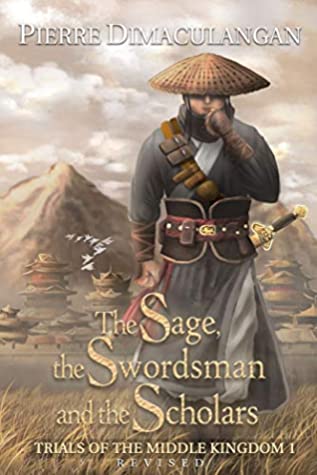
I picked up The Sage, the Swordsman, and the Scholars, Trials of the Middle Kingdom I at Awesome Con 2019, where I met the author. I had seen a banner much like the cover illustration hanging over the tables a couple rows away from my own, and I just had to check out the book.
Pierre Dimaculangan was really friendly, and his passion for his work was immediately apparent.
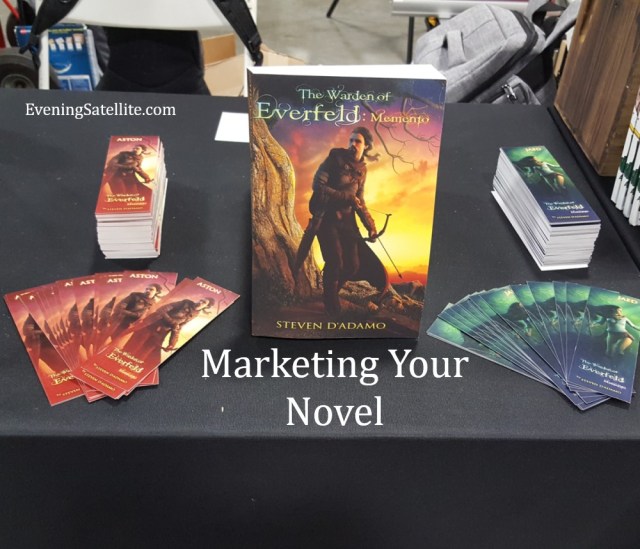
Well, it’s not quite the end of 2020, but I’m ready to put a pin in my marketing goals for this year. The main reason: marketing did not go well for me. I can likely point to a number of reasons that this is the case, but the primary one is that I was likely too ambitious to start the year, and even a little too ambitious with my adjusted goals at the mid-year point.
One key thing I’ve learned this year is to aim high in my goals while still being more pragmatic about which ones are really attainable. Let’s dig in. Continue reading “2020 Marketing Goals Wrap-Up”→
Welcome to part two of my series on strategies to promote a new book release. This time, we’re going to take a closer look at running giveaways for your new book.





 Evening Satellite Publishing